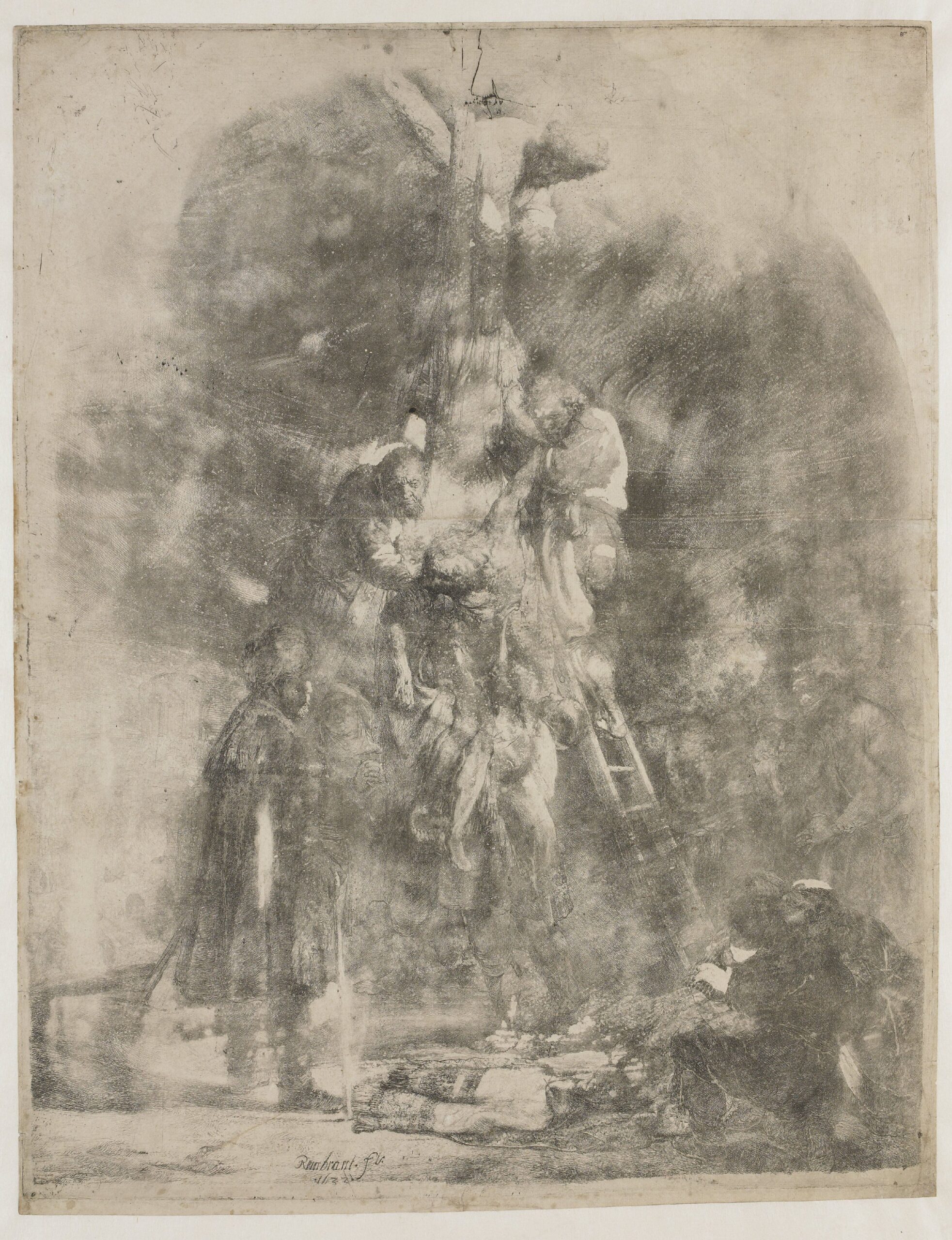
The plate failed in the biting and was probably destroyed or reused.
Rarity of impressions
In auctions (2000-2025): not seen in auctions
In collections (New Hollstein 2013): extremely rare Early: 6 ⦿⦿⦿⦿⦿⦿
Catalogue Nowell-Usticke (1967): O-, unobtainable
Description
This is the first of three prints Rembrandt would dedicate to this subject, but in this case the plate completely failed in the biting. Into the 19th century it was believed that the next etching (B81-II) was a second state of this one, it is now clear that Rembrandt abandoned the plate and started the project with a new one.
Story
As described in John 19, verses 38-40, the body of Jesus was removed from the cross and wrapped in linen by Joseph of Arimathea, one of His disciples.
Inspiration
It is generally assumed that Rembrandt based the composition on an altarpiece by Rubens in the cathedral of Antwerp or, more likely, on the engraving after it by Lucas Vorsterman of 1620 (Hollstein 31).
Broos points at a woodcut by Albrecht Altdorfer (1480-1538).
Related
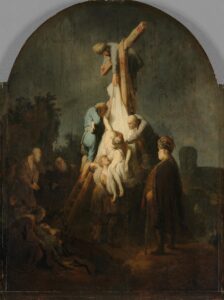
Rembrandt – The Deposition – ca 1635 – 89×65 cm – The Alte Pinakothek – Corpus A65
A year later Rembrandt painted the same subject in a very similar composition for prince Frederick Henry (Corpus A65, Bredius 550, now in the Alte Pinakothek in Munich).
Attributions and reviews
It is now generally assumed that Rembrandt made the original drawing to be transferred to the copperplate and left the etching to Johannes van Vliet, with whom he worked in the period between 1631 and 1636. It may be that Rembrandt took control when the first prints failed miserably.
States
All authors list one state only.
Prints and collections
Only three complete impressions of this plate are known, in the Rijksmuseum, in the British Museum and in the Bibliothèque Nationale.
There is a fragment with only the three heads in the Albertina (R264).
Watermarks
IHP with countermark R.
Literature
H 102, BB 33-B, G 84(I), M 186, Mz 197, RA 264, Cl 83, W 83, Bl 56, Du 88, CD 76 Rembrandt & Van Vliet 1996, p. 73-75; Hinterding 2008, p. 178ff;