B 82

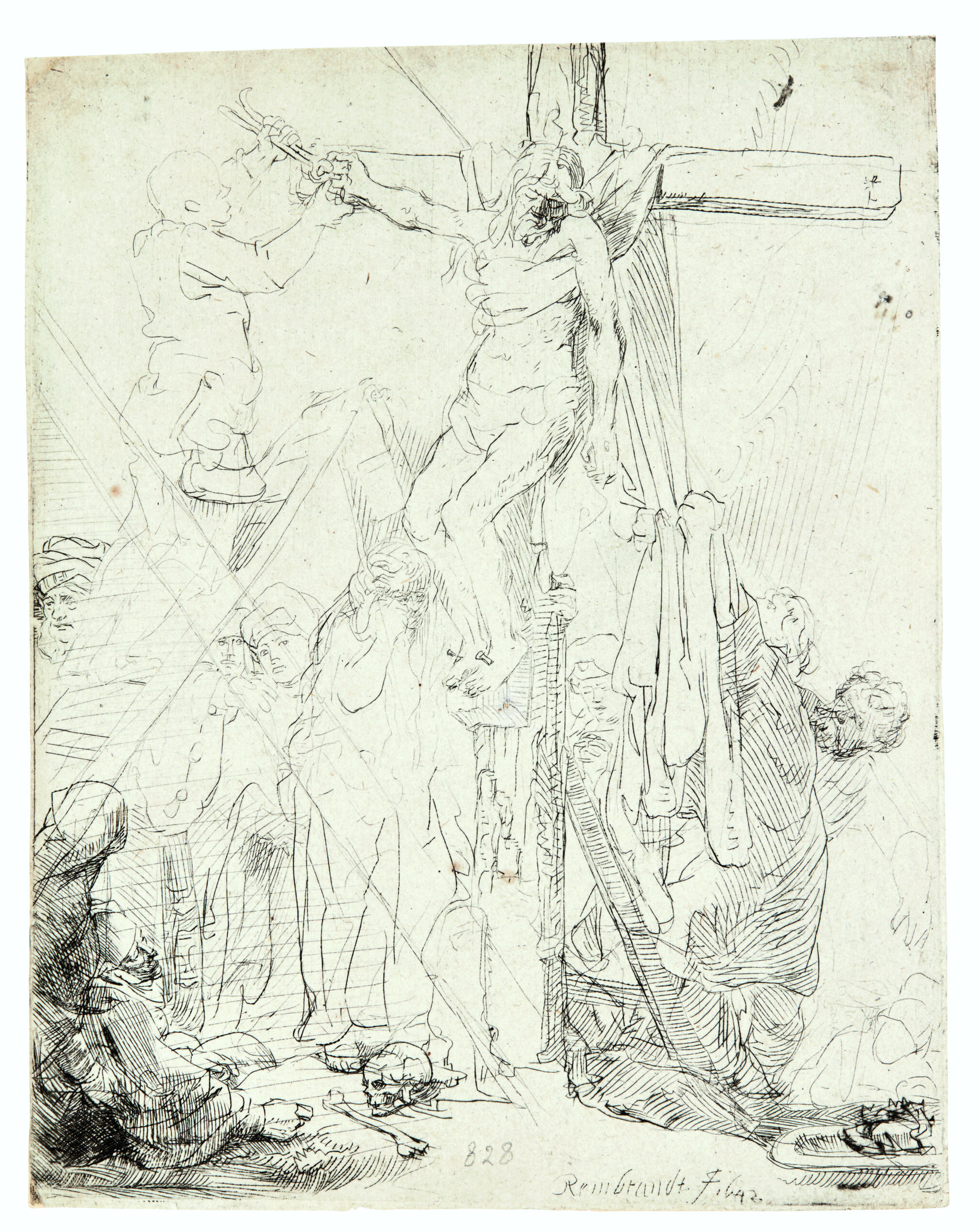
The descent from the cross, a sketch

  • French title:
    La descente de croix
  • German title:
    Die Kreuzabnahme, Skizze
  • Dutch title:
    De kruisafname, een schets
  • New Hollstein:
    204
  • Rembrandt in Black & White:
    213

Etching and drypoint. 1642.
Size: 149 x 116 mm. Surface: 173 cm2.
Signed and dated, in the lower margin: Rembrandt. f. 1642

NH 204 – Only state

Copper Plate

The copperplate may have been in the sale by Clement de Jonghe (1679 as 66 afneemingh vant cruys) but has not been seen since and is probably not in existence.


Rarity of impressions

  • In auctions (2000-2025): rare                                                                  Early: 10                                          ⦿⦿⦿⦿⊙⊙

  • In collections (New Hollstein 2013): rare                                               Early: 45                                      ⦿⦿⦿⦿⊙⊙

  • Catalogue Nowell-Usticke (1967): RR, a rather rare sketch plate.                                                            ⦿⦿⦿⦿⊙⊙


Story

John 19, verses 38-40
Joseph of Arimethea, a secret follower of Jesus, got permission from Pilatus to remove the body of Jesus from the cross to bury Him. Here the action is seen when the body is wrapped in linen and taken off by a group of followers.


Picture

This is the second of three prints showing the descent from the Cross. Rembrandt made several etching which were, on purpose, only lightly bitten, especially in this period. See also B 147 Old man in meditation and B231, The boathouse. Hinterding thinks that this is one of the unfinished etchings, similar to The Artist drawing from a model (B 192) and Old man shading his eyes with his hands (B 259). This is, however, in contradiction with the fact that Rembrandt signed the plate and obviously considered it completed.


Inspiration

The lowering of the body by a cloth slung beneath his arms and Mary in agony in the foreground can also be seen in an engraving by Mantegna (1431-1506) that was frequently used as a model all over Northern Europe (Bartsch 4). There were several works by Mantegna in the inventory of Rembrandt in 1656.


Related

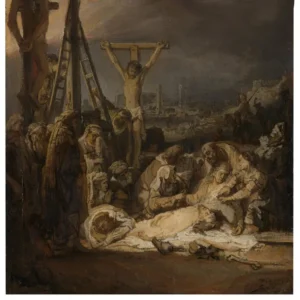
RembrandtThe Descent from the Cross – ca 1635 – 32×27 cm – National Gallery London – Bredius 565

Around 1642 Rembrandt painted the same subject (Bredius 565, now in the National Gallery in London).
Münz pointed at the huddled figure of the Virgin, similar to that of the Sick Woman (B359). He also states that the composition follows the painting of 1634 (Corpus C49, Bredius 551, now in the Hermitage), but that painting is now considered to be a product of the workshop.


States

All authors mention one state only. Early impressions show much burr.


Prints and collections

There are impressions in the British Museum, in the Rijksmuseum, in the Bibliothèque Nationale and in the Fitzwilliam Museum (Cambridge, UK).
There are counterproofs in Brussels and in the Teylers Museum in Haarlem.


Watermarks

Foolscap; Strasbourg bend (1646); Strasbourg lily with cm WK’ (two editions, one c.1652).


Literature

H 199, BB 42-C, G 85, M 216, Mz 213, RA 267-268, Cl 86, W 87, Bl 57, Du 89, CD 154
Hinterding 2008, p. 182-183; Rijke traditie, p. 68;


Rembrandt in Black & White: 213

New Hollstein/White-Boon: only state.
A good impression, with vertical polishing scratches and touches of burr on the foreground.
Sheet: 148/150 x 117/118 mm, Thread margins of 1 mm at both sides, cut on the platemark at top and bottom (+1%).
No watermark, horizontal chain lines at approx. 23 mm.


Provenance

In the collection of Charles Scarisbrick, Sheriff at Scarisbrick Hall, Lancashire (1801-1860, Lugt 522), his collector’s mark in black ink verso. This collection, which may have included works coming from Mariette, was auctioned posthumous at Christie’s, Manson & Woods in London in May 1861.