B 98

The baptism of the eunuch

  • French title:
    Baptême de l’eunique
  • German title:
    Die Taufe des Kämmerers
  • Dutch title:
    De doop van de kamerling
  • New Hollstein:
    186
  • Rembrandt in Black & White:
    230

Etching with touches of drypoint. 1641.
Size: 178 x 213 mm. Surface: 379 cm2.
Signed and dated, in the lower right corner: Rembrandt. f. 1641

NH 186 – 2nd state of IV

Copper Plate

The copperplate was in the sale by Clement de Jonghe (1679, as 255 de Moor gedoopt). The next, anonymous owner added a +-sign (ca. 1700). It later appeared in the sale by Pieter de Haan (1767, lot 33) and was sold via Fouquet to Claude-Henri Watelet (1786). It then became part of the set of plates subsequently owned and used for printing Recueils by Pierre-François Basan, Henri-Louis Basan (his nr 2287/), Auguste Jean (ca 1809), Veuve Jean, Auguste and Michel Bernard (1846) and Robert Lee Humber (1937). It was sold at the Artemis sale in London (1993) and is now in the Bibliothèque Nationale de France.


Rarity of impressions

  • In auctions (2000-2025): very frequent                                                 Early: 13 – Late: 54                     ⦿⊙⊙⊙⊙⊙

  • In collections (New Hollstein 2013): frequent                                      Early: 48 – Late: 27                      ⦿⦿⊙⊙⊙⊙

  • Catalogue Nowell-Usticke (1967): C2-, a common plate                                                                              ⦿⊙⊙⊙⊙⊙


Story

Acts of the Apostles 8, verses 26 to 39
The apostle Philip, on his way from Jerusalem to Gaza, converted and baptised a eunuch from the court of Queen Candice of Ethiopia. Due to the reversal effect of the printing the apostle seems to use his left hand, which is not as it should be.


Picture

Note the person sitting on the bank of the river, just right of the folded hands.


Animal Farm


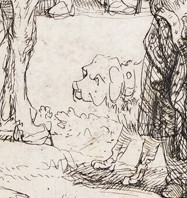
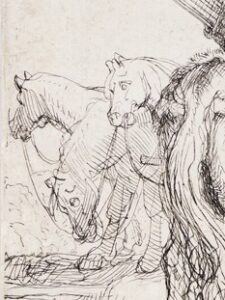
A bulldog look-alike is hiding behind the boyish servant. It is probably not aware of the importance of the scene. Nor are the three horses that seem to be attached to a wagon. The most notable animal is the horse on which the master servant is sitting.


Related
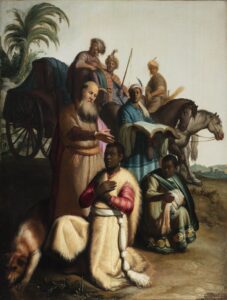
RembrandtThe baptism of the Eunich – 1626 – Catherijneconvent Utrecht – Corpus A5

Rembrandt must have been impressed by this episode of the Bible, since he made this etching and two paintings of it. He may have been ‘infected’ by his master Pieter Lastman, who made four paintings. His work clearly influenced the two first versions by Rembrandt, one of 1626 now in the Catherijneconvent in Utrecht (Corpus A5, Bredius 460), The second of ca. 1631 is known by a copy etched by Johannes van Vliet (1631, Hollstein 12). It has long been considered lost, but it may be the painting discovered in the collection of Bernard Allien (see Schwartz 2020).
There is a drawing in reverse of about 1640 of which only a copy is still existing (Rijksmuseum, 363, verso)
The figure of the eunuch can also be found in a drawing in red chalk of 1635, in the Albertina (Benesch 357).
Münz considered a drawing in the Louvre (Benesch 488) to be an example, but it is now attributed to Govert Flinck.


Copies

The New Hollstein lists four copies in reverse. Copy A is by Melchior Küsel, inscribed Actor. Cap. VIII, 26 Philippus batizat Eunuchum and numbered 21 (1679, 93 x 140 mm). Copy B is anonymous, signed Rembrandt f. 1641 (177 x 216 mm, WB 2). Copy C is also anonymous (155 x 210 mm, WB 3). Copy D is anonymous, attributed to van Vliet by White-Boon (174 x 212 mm, WB 1).


Attributions and reviews

The plate is not by Rembrandt according to Singer.


States

As most authors, NH lists four states, of which the final two not by Rembrandt. The 3rd state (with +-sign) is ‘new’. White-Boon list two states, Nowell-Usticke four states. From his 2nd state there are later impressions by Watelet, P.Basan, Basan, Jean, Bernard and Beaumont.
In the 1st state (NH, WB, R306-307) the waterfall is almost white and the bank at the right side is only lightly shaded.
In the 2nd state (NH, WB final, R308, NU Watelet?) fine drypoint shading is added to the waterfall and the bank and their reflection in the pond.
In the 3rd state (NH, NU Basan?) an unknown owner has added a plus sign in the lower left corner. Outlines seem stronger than before, an accidental scratch runs from left to right about 15 mm to the right of the head of St. Philip.
In the 4th state (NH, NU, Jean, Bernard, Beaumont) the plus-sign of the 3rd state is not visible. There is a strong band of right-to-left shading across the top of the cascade°. Some areas are darkened, like the inside of the sleeve of St. Philip*, the area right of his head*, the umbrella* and the shadow of the right leg of the eunuch*. In later impressions there are several irregular rust patches in the blank space upper left.


Prints and collections

Of the 1st state only five impression are known, all in greyish ink.


Recueils

The etching appears in the Recueil de Basan, impressions fair (NU).

B&W 54 – Recueil de Basan – Page 27                   NH: 3rd state of IV/WB: 2nd and final state.
A somewhat light impression, the accidental scratch well visible. The +sign in the lower left corner is vaguely visible.

B&W 206 – Recueil de Beaumont –  Sheet 34      NH: 4th and final state/WB: 2nd and final state.
A good impression, showing much detail. The additional shadows are well visible.


Watermarks

In the 1st and 2nd state: Basilisk (1640-47);
In the 2nd state: Strasbourg lily (1653); Foolscap with seven-pointed collar; Serpent;
In the 3rd state: Seven Provinces (after 1665); Foolscap with seven-pointed collar with cm PvL (1675 or later); Pro Patria (1699 or later); Arms; Strasbourg lily;


Literature

H 182, BB 41-E, G 95, M 210, Mz 211, RA 306-308, Cl 101, W 103, Bl 69, Du 101, CD 146
Hinterding 2008, p. 212-213; Schwartz 2020;


Rembrandt in Black & White: 230

New Hollstein: 2nd state of IV/White-Boon: 2nd state of II.
A good impression of the contemporary 2nd state. The plus sign and the scratch, typical for the 3rd state, are not visible. Nor are the added areas with shading of the 4th state.
Sheet: 178 x 214 mm, cut at the platemark (0%).
Watermark: Basilisk with countermark RP, Ash/Fletcher 12 A.a, listed in NHD for both the 1st and 2nd state, between 1640 and 1647. Horizontal chain lines at approx. 23 mm.


Exhibitions

Rembrandt, de fotograaf, Westfries Museum (Hoorn), June 2024 – January 2025;