B 93

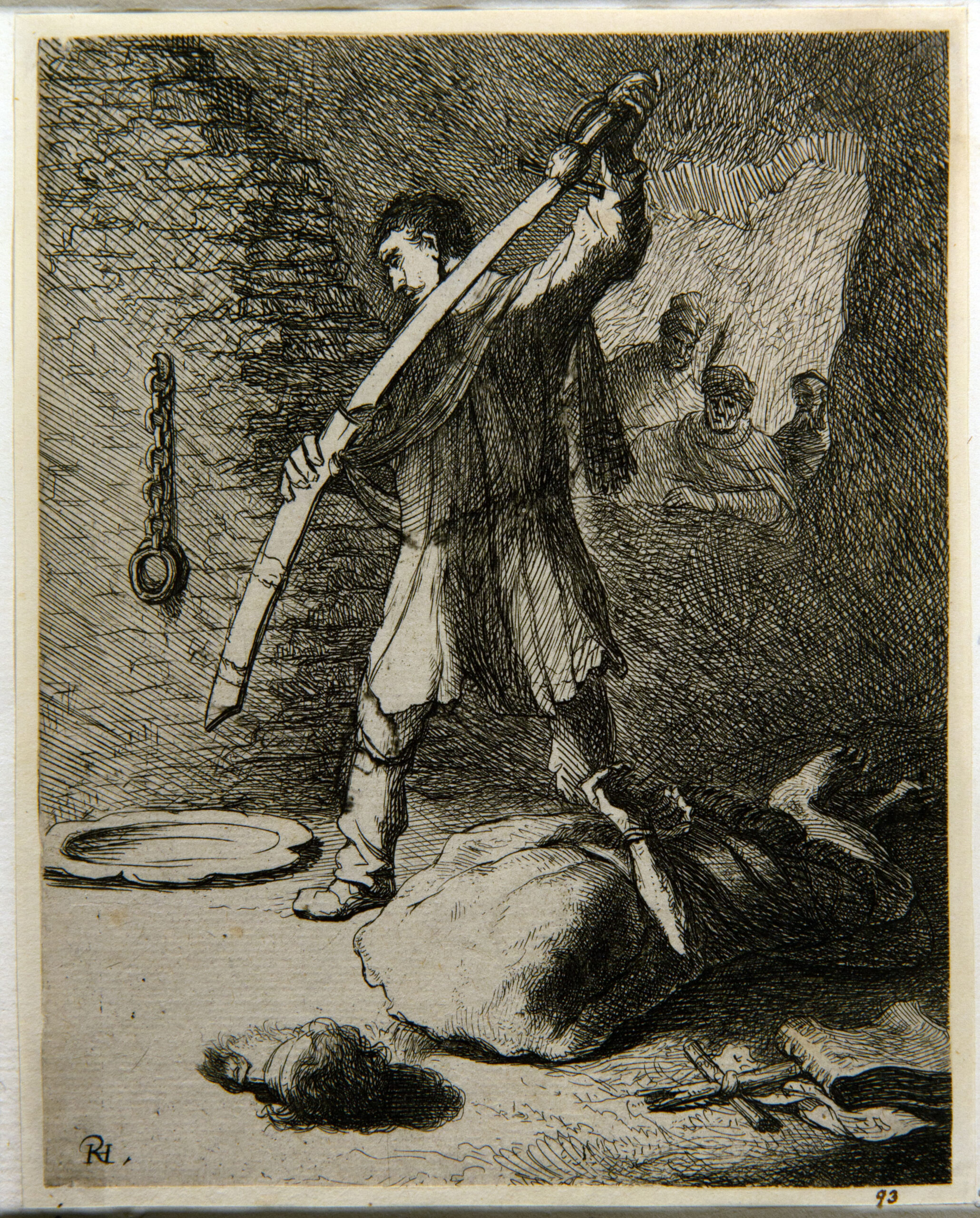
The beheading of St.John the Baptist

  • French title:
    La décollation de Saint Jean Baptiste
  • German title:
    Die Enthauptung Johannes des Täufers
  • Dutch title:
    De onthoofding van Johannes de Doper
  • New Hollstein:
    109
  • Rembrandt in Black & White:
    77

Etching and burin. Ca. 1631.
Size: 157 x 124 mm. Surface: 195 cm2.
Signed in monogram with the burin (NH: not by Rembrandt) in the lower left corner: RHL.  Not dated.

NH 109w – 7th state of VII

Copper Plate

The plate was not part of any early sale or collection and is probably not in existence.


Rarity of impressions

  • In auctions (2000-2025): extremely rare                                             Early: 3                                            ⦿⦿⦿⦿⦿⦿

  • In collections (New Hollstein 2013): very rare                                    Early: 41                                          ⦿⦿⦿⦿⦿⊙

  • Catalogue Nowell-Usticke (1967): rare, rejected by many


Story

Matthew 14, verses 3–11 and Marcus 6: 24-28
King Herod ordered the beheading of John the Baptist as a reward for a dance performed by his stepdaughter Salomé. She asked for this reward on a suggestion by her mother Herodias, the king’s new wife.


Picture

In line with the traditional way of portraying this scene, Rembrandt shows the moment just after the execution, when the executioner puts the sword back into the sheave. In a later version (B 92) he will take a moment just before the execution, with John praying. Note the audience of three, peeping through the window.


Inspiration

According to Münz a woodcut by Lucas Cranach is the basis for this composition.


Related

There is a drawing by Rembrandt (Benesch 101, now in the Louvre) which, according to Lugt, was a first sketch for this print. But Benesch dates the drawing in 1635 ignoring the link with the etching.


Copies

There is an anonymous, 18th century copy in reverse, inscribed RH (152 x 120, WB).


Attributions and reviews

This is one of the etchings of which the authenticity has been frequently debated. Gersaint still accepted is as authentic, but soon after Helle and Gloomy attributed the work to Jan Lievens. Rovinsky and Biörklund later supported that view.
According to Hind the etching is by Johannes van Vliet.
Finally Münz suggested that Van Vliet has reworked the plate.
White-Boon and Hinterding support that view, mainly because stylistically the 1st state fits well into the early works of Rembrandt as The flight into Egypt (B 54) and St.Jerome kneeling (B 106). Dr. Jan Six has defended the attribution to Rembrandt based on the relationship with B 54 and B 50.
NH considers this an original by Rembrandt of which earlier states are not available, later reworked in the workshop. Watermarks used in the first four states confirm this view.


States

The New Hollstein lists seven states, all by the workshop. Most other authors list four states, White-Boon five, Nowell-Usticke: one trial proof and four states.
In the 1st state (trial proof NU) there are two steps above the dish at left and a white background in the grotto. The corners are rounded.
In the 2nd state (NHD) the background in the grotto is shaded. The highlights on the two figures in the grotto are shaded out. The corners are now square.
In the 3rd state (NHD/2nd state WB/1st state NU) many changes are made, see NH.
In the 4th state (NHD/3rd state WB/2nd state NU) the steps are removed. There is shading on the upper wall. Many other changes noted by NHD.
In the 5th state (NHD/4th state WB/3rd state NU) the plate is reworked with the burin. The lower part of the wall is shaded.
In the 6th state (NHD) the executioner is shaded all over.
In the 7th state (NHD/5th state WB/4th state NU) shadows are added to the coat and between the knees of the executioner.


Watermarks

In the 1st state: Arms of Burgundy; Arms of Austria with cpuntermark (c. 1632).
In the 2nd and 3rd state: Strasbourg lily. In the 4th and 6th state: Strasbourg lily with IB.
In the 5th state: Single headed eagle with the Basel crosier (1635).
In the 7th state: Foolscap with five-pointed collar.


Literature

H 308, BB Rej.6, G 93, M -, Mz 289, RA 296-298, Cl supp 25, W -, Bl -, Du -, CD 311
Tümpel p. 72; Jan Six in Oud Holland xxvii, p. 85, 1909; Rembrandt & Van Vliet 1996, p. 77; Rembrandts passie, p. 90-91; Hinterding 2008, p. 204ff;


Rembrandt in Black & White: 77

New Hollstein: 7th and final state/White-Boon: 5th and final state
A very good, dark impression. With warm plate tone and selective wiping.
Sheet: 157 x 124 mm, no margins, cut on the plate line on all sides (=0%). The sheet is attached to a thin backing paper and then again on thick laid paper. As a consequence it was not (yet) possible to identify a watermark and/or chain lines.


Exhibitions

Rembrandt in Zwart-Wit, Museum Gouda, July – October 2014;