B 179

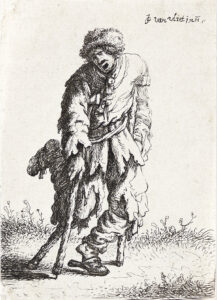
Beggar with a wooden leg

  • French title:
    Gueux estropie
  • German title:
    Der Stelzfuss
  • Dutch title:
    Bedelaar met een houten been
  • New Hollstein:
    49
  • Rembrandt in Black & White:
    236

Etching. Ca. 1630.
Size: 114 (from the 2nd state 112) x 66 mm. Surface: 75 cm2.
Not signed, not dated.

NH 49 – 3rd state of IV

Copper Plate

The copperplate was in the sale by Clement de Jonghe (1679) as 22 capiteyn eenbeen (Captain one-leg). The next, anonymous owner added two dots and a plus-sign (ca. 1700). It later appeared in the sale by Pieter de Haan (1767, lot 51) and was sold via Fouquet to Claude-Henri Watelet (1718-1786). It became part of the set of plates subsequently owned and used for printing Recueils by Pierre-François Basan (1723-1797), Henri-Louis Basan (his nr 1426), Auguste Jean (ca 1809), Veuve Jean, Auguste and Michel Bernard (1846) and Robert Lee Humber (1937). It was sold at the Artemis sale in London (1993) and is now in the Rembrandthuis (Amsterdam).


Rarity of impressions

  • In auctions (2000-2025): frequent                              Early: 11   Late: 12   Unknown: 27       ⦿⦿⊙⊙⊙⊙

  • In collections (New Hollstein – 2013): frequent                     Early: 51   Late: 26                    ⦿⦿⊙⊙⊙⊙

  • Catalogue Nowell-Usticke (1967): C2+, fairly common                                                              ⦿⊙⊙⊙⊙⊙


Description

This etching is part of the series of beggars and street folk Rembrandt made around 1630. Rembrandt treats his subject with much respect. Quite contrary to the way beggars with a wooden leg were normally treated by ‘the public’.


Related

B&W 383 – Jan Gilliszn van VlietBeggar with a wooden leg


For all prints showing beggars, Rembrandt was inspired by a series made around 1622 by Jacques Callot (1592-1635), which Rembrandt owned. In this case there is a clear resemblance to Callot’s Beggar with a wooden leg.

Rembrandts’ friend Jan Gilliszn van Vliet made a similar etching. It is included in the collection “Rembrandt in Black & White”, number 383.


Copies

There is one copy (A) in the same direction, by David Deuchar, with the head only (47 x 33 mm, WB only).
There are two copies in reverse. Copy B is an anonymous one, signed Rembrandt F (121 x 75 mm). One signed N.Gamppenborg 1818 (115 x 65 mm) is not included in NH.


Attributions and reviews

The plate was made by a pupil according to Coppier.


States

NH lists four states, of which the final two not by Rembrandt. Most other authors list two states, Nowell-Usticke three, from his 2nd state there are later impressions by P.Basan, Basan, Jean, Bernard and Beaumont.
In the 1st state (NH, WB, R510, NU) the plate is slightly larger (114 mm) at the bottom. The stick is well clear of the bottom of the plate. A long horizontal scratch runs in the lower right corner. The edges are uneven and the corners sharp.
In the 2nd state (NH, WB, R511-512, NU) the plate is slightly smaller at the bottom (112 x 66 mm). The end of the stick is now just above the baseline. The corners are slightly rounded. Only one horizontal line in the lower right corner.
In the 3rd state (NH/later 2nd state WB final, NU P.Basan, Jean) an unknown owner added a plus (+) in the lower right corner and two dots in the upper right corner. In later impressions there are two long scratches in the blank space at right, approx. 2 inches from the bottom and (later) some rounded scratches in the upper left corner (by Jean?).
In the 4th state (NH/3rd state NU Bernard, Beaumont) the plate is coarsely rebitten. The two scratches at the right are removed. The extreme right outline of the cloak is very coarse (earlier very fine).


Prints and collections

Nowell-Usticke considers the impressions in the Recueil de Basan to be fairly strong.


Watermarks

In the 2nd state: Arms of Amsterdam.


Literature

H 12, BB 30-4, G 172, M 35, Mz 116, RA 510-512, Cl 176, W 176, Bl 142, Du 175, CD 10
Hinterding 2008, p. 330; Dat kan beter ! 2013, p. 16; Kroniek 2016, p. 74-76;


Rembrandt in Black & White: 236

NH: 3rd state of IV/WB: 2nd and final state.
A later impression on very thin laid paper. The two dots in the upper right corner are well visible, as are the two scratches at right, confirming a 3rd state.
Sheet 116 x 69 mm, thread margins of 1 to 2 mm all around (+8 %), slightly irregular at the left side.
No watermark, vertical chain lines at approx. 34 mm


Provenance

In the collection of the Kupferstichkabinett Berlin, their stamps in black ink visible verso (Lugt 1633 and 2398, the duplicate stamp).
In the collection of Adam Gottlieb Thiermann (Lugt 2434) his collection mark verso. The print was probably in his sales in 1862 or 1881.


Exhibitions

Rembrandt, 17th century photographer, Daegu Art Museum (Korea), November 2023 – March 2024;
Rembrandt, de fotograaf, Westfries Museum (Hoorn), June 2024 – January 2025;