
B 277

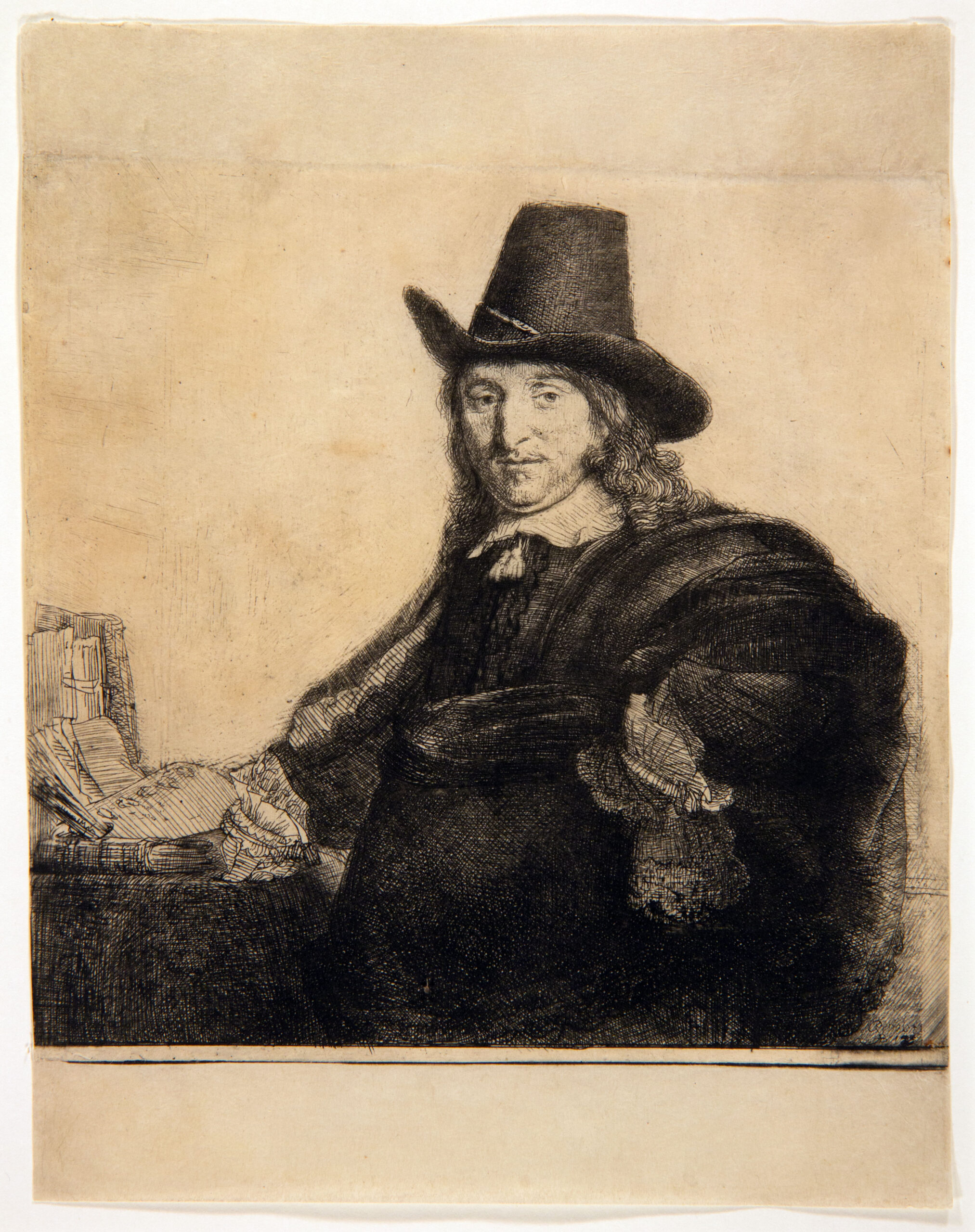
Jan Asselyn, painter (‘Krabbetje’)

  • French title:
    Jean Asselin – Crabbetje
  • German title:
    Jean Asselijn
  • Dutch title:
    Jan Asselijn (‘Krabbetje’)
  • New Hollstein:
    236
  • Rembrandt in Black & White:
    65

Etching, drypoint and burin. Ca. 1647.
Size: 216 x 170 mm. Surface: 367 cm2.
Signed in the lower right corner: Rembr. f. 16 (?). Dated 1647 by most authors.

NH 236 – 2nd state of VII

Copper Plate

The copperplate was initially in the hands of an anonymous owner, who added two dots in the top right corner. It later appeared in the sale by Pieter de Haan (1767, lot 66) and was sold for Fl 9,00 via Fouquet to Claude-Henri Watelet (1718-1786). It then became part of the set of plates subsequently owned and used for printing Recueils by Pierre-François Basan (1723-1797), Henri-Louis Basan (his nr 1438), Auguste Jean (ca 1809), Veuve Jean, Auguste and Michel Bernard (1846) and Robert Lee Humber (1937). It was sold at the Artemis sale in London (1993) and is now in the Palace Huis ten Bosch Museum in Nagasaki.


Rarity of impressions

  • In auctions (2000-2025): very frequent                        Early: 11    Late: 46    Unknown: 3   ⦿⊙⊙⊙⊙⊙

  • In collections (New Hollstein – 2013): very frequent           Early: 47    Late: 74                     ⦿⊙⊙⊙⊙⊙

  • Catalogue Nowell-Usticke (1967): C2, common in later states                                                  ⦿⊙⊙⊙⊙⊙


Subject/Sitter

Jan Asselyn was a painter of landscapes (ca. 1615-1652). He returned from Rome in 1647. He married the sister of Rembrandt’s pupil Ferdinand Bol and became a citizen of Amsterdam just a few months before his death in 1652. He was quite small and had a deformed left hand, which led to his nickname Krabbetje (little crab). The books on the left side are pointing at Asselyn’s affection for reading. The painting on the easel in the 1st state shows the specialty of the sitter, landscapes.


Picture

In order to make the sitter look taller Rembrandt used a low viewpoint. White cuffs are added to the cloak of black satin in order to hide the hands. It is the only portrait Rembrandt made of a fellow painter, a somewhat remarkable feature given the many painters and pupils he was constantly surrounded with (Stephane Dickey). It is not known if the portrait was commissioned and, if so, by whom. It could have been Jan’s brother Thomas, who was a friend of Rembrandt and at least twice acted as his witness in commercial transactions. The fact that the background was completely erased in the 3rd state, rather than redrawn, may indicate that this state was used for commercial purposes, maybe even as a memorial.


Related

The posture looks similar to that of another portrait of a painter, the portrait of Paulus Potter by Bartholomeus van der Helst.


Copies

There is one copy (A) in the same direction, signed Rembrandt. f. (190 x 162). There is also one copy (B) in reverse by Ignace de Claussin, signed De Claussin f. in which the head is replaced by the head of Rembrandt (182 x 168 mm).


Attributions and reviews

The etching is considered as special by Rovinsky and Singer.


States

NH lists seven states, only the first two by Rembrandt. The 3rd state, with the two dots, is ‘new’. Most other authors list three states, Biörklund four, Nowell-Usticke six. From his 3rd state there are later impressions by Watelet, P.Basan, Basan, Jean, Bernard and Beaumont.
In the 1st state (NH, WB, R738, NU) there is an easel and a picture of a landscape in the background. Some impressions show scratches to the left of the hat, according to Benesch a state between 1 and 2.
In the 2nd state (NH, WB, R739, NU) the easel and picture are burnished out, but traces are still visible in early prints. They later wear out or are burnished on purpose.
In the 3rd state (NH only) two dots are added in the upper right corner.
In the 4th state (NH/3rd state WB final, NU) the last traces of the easel are gone and dark shadows are added with fine shading in the hat and cloak. Shading is added by use of a rocker in various places, like on the upright book on the left, and the triangle thereunder and inside the contour of the cloak in the lower right corner.
In the 5th state (NH/4th state NU Watelet, P.Basan) the face is retouched, like shading added under the right eyebrow, under the right eye and along the right cheek. It seems that the pupils are smaller (JM).
In the 6th state (NH H. Basan/5th state NU Jean) there new shading right of and over the left shoulder and crosshatching in the blank space to the left of the right cheek.
In the 7th state (NH/6th state NU Bernard, Beaumont) the plate is entirely reworked. A new highlight appears on the hat.


Prints and collections

Of the 1st state about twenty impressions are recorded, including some on Indian paper, on yellowish oatmeal paper (in the Albertina and the Louvre) and on vellum (in the Kupferstichkabinett in Berlin). Of both early states there are impressions on Japanese paper.
There is a counterproof in the Albertina (not in NH).
Nowell-Usticke considers the impressions in the Recueil de Basan, to be fair.


Watermarks

In the 1st state: Wheel (c. 1647).
In the 2nd state: Posthorn with cm IB. In the 3rd state: Seven provinces (> 1665); Strasbourg lily. In the 4th state: Arms of Amsterdam; Strasbourg bend; Strasbourg lily.
In the 5th state: Countermark MA.


Literature

H 227, BB 47-1 , G 257, M 161, Mz 71, RA 738/740, Cl 274, W 279, Bl 171, Du 255, CD 184, S 123-124.
Dickey 2004, p. 120-125;


Rembrandt in Black & White: 65

NH: 2nd state of VII/WB: 2nd state of III.
A good, early impression on Japanese paper. The remains of the easel as shown in the 1st state still visible left of the sitter. The rework with the rocker not yet visible, like in the triangle under te books, confirming a 2nd state.
Sheet 216/217 x 170/169 mm. The two blank strokes in top and bottom of the original sheet are cut and replaced by two strokes of similar Japanese paper of exactly the same size.


Exhibitions

Rembrandt in Zwart-Wit, Het Hannemahuis (Harlingen), June – August 2014; Stedelijk Museum Vianen, October 2017 – January 2018;
Rembrandt in Black & White: Chateau de Penthes (Geneva), July-October 2016;
Rembrandt, de fotograaf, Westfries Museum (Hoorn), June 2024 – January 2025;