B 177

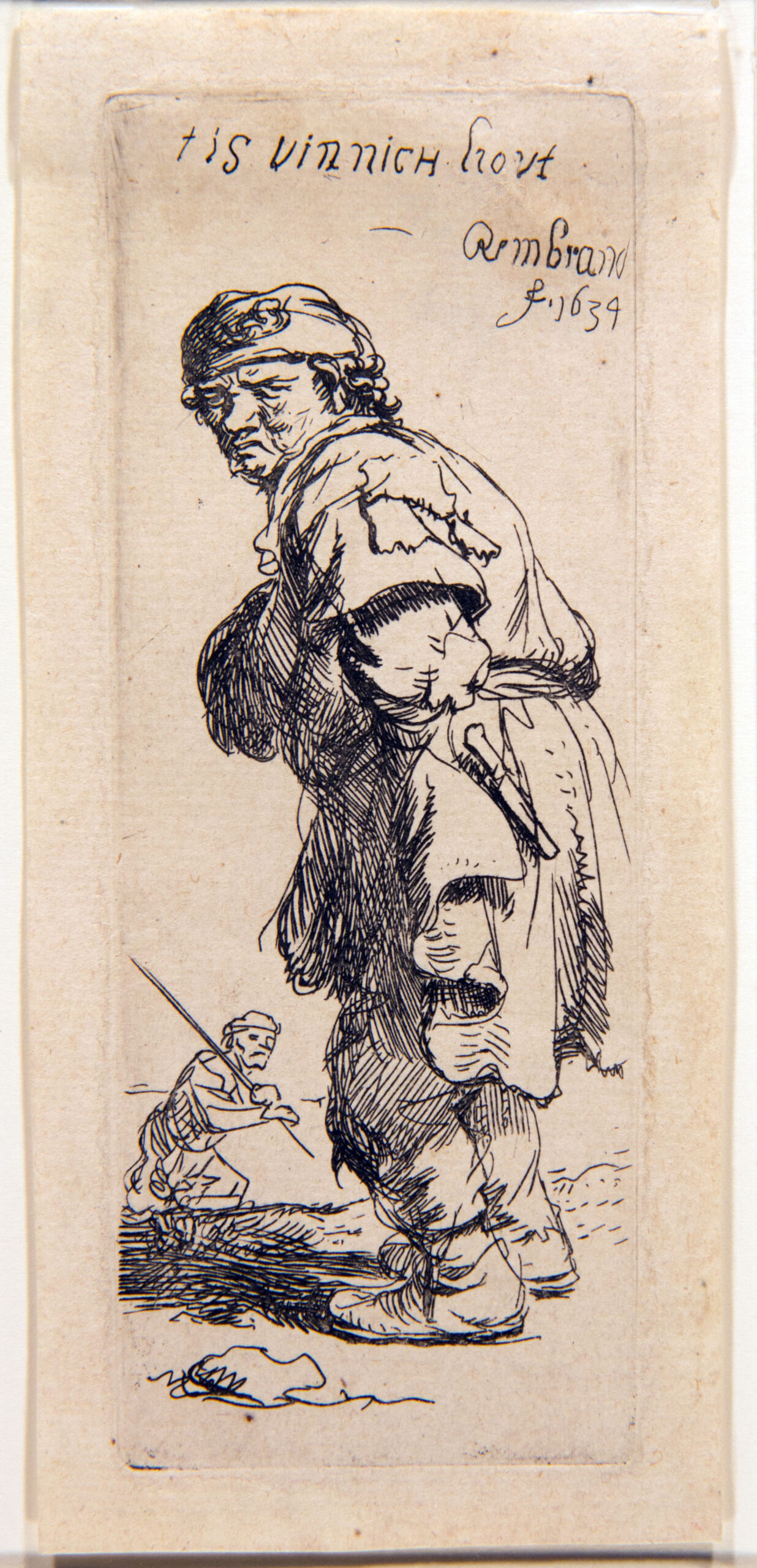
A peasant calling out: ‘Tis vinnich kout’

  • French title:
    Deux gueux en pendants
  • German title:
    Stehender Bauer ‘Tis vinnich kovt’
  • Dutch title:
    Een boer uitroepend ´T’is vinnig kout´
  • New Hollstein:
    131
  • Rembrandt in Black & White:
    57

Etching and drypoint. 1648.
Size: 165 x 128 mm. Surface: 211 cm2.
Signed and dated in the bottom right corner: Rembrandt f. 1648

NH 131 – Only state

Copper Plate

The copperplates of B 177 and B 178 were not part of any of the major, early collections and are probably not anymore in existence.


Rarity of impressions

  • In auctions (2000-2025): rare                                                  Early: 15                                       ⦿⦿⦿⦿⊙⊙

  • In collections (New Hollstein – 2013): rare                             Early: 43                                      ⦿⦿⦿⦿⦿⊙

  • Catalogue Nowell-Usticke (1967): RR-, very scarce                                                                    ⦿⦿⦿⦿⊙⊙


Description

The two etchings, B 177 and B 178, are unique in the work of Rembrandt, not only because the two clearly are meant as a pair, but also because it is the only occasion that a text is added by Rembrandt himself. Another peculiarity is the fact that the two subjects are not facing each other, but are back-to-back. It is probably one of the few moments where Rembrandt did not take the effect of the reversal into account, since he started to make impressions in which the men are facing each other (178 on the left, 177 on the right side) with the ‘wrong’ sequence of the text as a result.


Picture

The skater in the background leaves no doubt about the time of the year in which the scene is placed. The long stick in the skaters hand can also be seen in The Skater (B156). It is meant to serve as a live-saving tool in case of a hole in the ice.


Title

In the catalogue of the de Burgy sale in 1755 the pair was listed as De Twé Schurkjes (The two Rogues).


Related

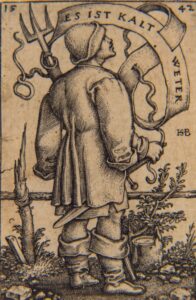
Hans Sebald Beham – Es ist kalt Weter – Bartsch 188

Seymour Haden was the first to point at two small engravings by Hans Sebald Beham (Bartsch 188 and 189) that have obviously served as examples for these prints. The Beham prints show the texts: ‘Es is Kalt Weter’ and ‘Das schadet nit’. Hinterding explains that Rembrandt follows the original text closely, since Dats niet in 17th century Dutch has the same meaning as the German text (‘it does not matter’) and not the denial it means in present day Dutch (‘it is not cold’).
According to Joshua Rifkin Rembrandt became acquainted with the Beham prints during a visit of Burchhard Grossman to Amsterdam, at which occasion Rembrandt made a drawing in Grossmans Liber Amicorum. (see Literature)


Copies

There is a copy of the two etchings together in the same direction by John Holland, signed and dated JHolland after Remb: 1755 (112 x 93 mm, NH a, WB 2).
There is a copy of the two etchings together in reverse by De Claussin (110 x 45 and 112 x 40, NH 131b, 132c, WB 1) in three states, each one somewhat smaller.
One impression of the 1st state is on a plate (187 x 234 mm) together with B268, Young man with velvet hat, signed Rembrandt f. 1634.
There is also an anonymous copy in reverse of B178 only (108 x 42 mm, NH 132b).


Attributions and reviews

According to Coppier these etchings are not by Rembrandt.


States

All authors list one state only for both prints.


Prints and collections

Several impressions of the two prints on one sheet are known (like in the Lugt Collection, Paris).
There are no impressions in the Recueils, but they are included in Basan’s ‘Dictionaire de Graveurs’, Paris 1809


Literature

H 114, BB 34-E, G 171, M 112, Mz 127, RA 508, Cl 174, W 174, Bl 140, Du 173, CD 90, S 72.
Broos 1985, p. 42; Rohde 2005, p. 129; Hinterding 2006, p. 290; Hinterding 2008, p. 327; Rembrandts Radierungen 2011, p. 50; Rifkin 2020;


Rembrandt in Black & White: 57

Two very good, contemporary impressions on thin laid paper.
B 177/NH 131 B&W 57a: NH/WB: Only state.
Sheet: 127/125 x 57/56 mm, broad margins of 6 to 8 mm all around (+ 44%).
Fragment of an (as yet unidentified) watermark, vertical chain lines at approx. 24 mm.


Provenance

In the collection of Carl Benjamin Brüsaber, Secretary to the Senate of Hamburg (1815-1876, Hamburg, Lugt 311). His mark handwritten in graphite verso, on both prints.
Probably in his sale with Sagert & Cie in Berlin in April 1873.


Exhibitions

The Rotunda at Exchange Square, Hong Kong, January 2008;
Rembrandt in Zwart-Wit, Westfries Museum (Hoorn), Het Markiezenhof (Bergen op Zoom), Stedelijk Museum Zutphen, Het Hannemahuis (Harlingen), Museum Gouda, Jan ten Horne Museum (Weert), Stadsmuseum Harderwijk, (March 2013-August 2015); Stedelijk Museum Vianen, October 2017 – January 2018;
Rembrandt in Black & White: Schloss Britz (Berlin), Bozar Expo (Brussels), Chateau de Penthes (Geneva), November 2015-October 2016;
Rembrandt, fotograaf avant-la-lettre, Museum De Reede (Antwerp), January – May 2023;
Rembrandt, 17th century photographer, Daegu Art Museum (Korea), November 2023 – March 2024;
Rembrandt, de fotograaf, Westfries Museum (Hoorn), June 2024 – January 2025;