B 87

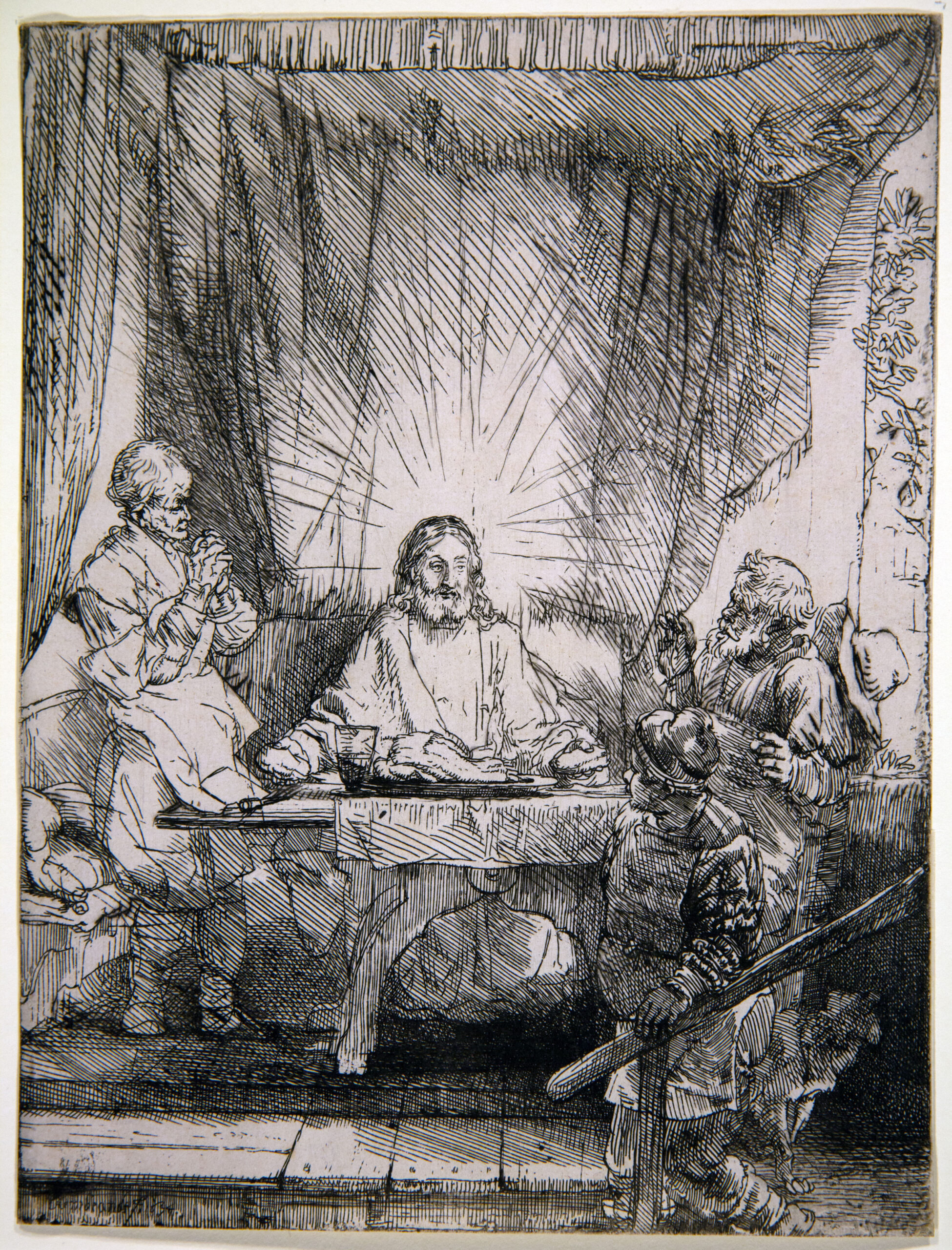
Christ at Emmaus: the larger plate

  • French title:
    Les disciples d’Emaus
  • German title:
    Christus in Emmaus
  • Dutch title:
    Christus in Emmaus (groot)
  • New Hollstein:
    283
  • Rembrandt in Black & White:
    147

Etching and drypoint (from the 2nd state). 1654.
Size: 211 x 160 mm. Surface: 338 cm2.
Signed and dated, in the lower left corner: Rembrandt f. 1654

NH 283 – 2nd state of V

Copper Plate

The copperplate was in the sale by Clement de Jonghe (1679, as 49 aevontmael Christi). The next, anonymous owner added two dots (ca. 1700). It later appeared in the sale of Pieter de Haan (1767, lot 30) and was sold via Fouquet to Claude-Henri Watelet (1718-1786). It then became part of the set of plates subsequently owned and used for printing Recueils by Pierre-François Basan (1723-1797), Henri-Louis Basan (his nr 1400), Auguste Jean (ca 1809), Veuve Jean, Auguste and Michel Bernard (1846) and Robert Lee Humber (1937). It was sold at the Artemis sale in London (1993) and is now in the Chicago Art Institute.


Rarity of impressions

  • In auctions (2000-2025): very frequent                                  Early: 10     Late: 58                    ⦿⊙⊙⊙⊙⊙

  • In collections (New Hollstein 2013): very frequent              Early: 43     Late: 55                    ⦿⊙⊙⊙⊙⊙

  • Catalogue Nowell-Usticke (1967): C2-, a common plate; fine early impressions rare        ⦿⊙⊙⊙⊙⊙


Story

After His resurrection Christ met with two of his disciples when he was heading for Emmaus. They did not recognize Him until they had dinner and Christ broke the bread.


Picture

It is remarkable that Rembrandt broke with the tradition (which he himself followed in the other etching of this subject, B88) to picture the moment of breaking the bread. Instead he moved the scene a few seconds later, just when the disciples realised who they were dealing with and what they were witnessing. As in all other versions of this scene, the innkeeper is present. But this time it not clear whether he is the ignorant by-stander he is normally shown to be. In 1654 Rembrandt made three other prints (B50, B83, B86), all very similar in style and size to this one. They may well have been meant as a series about important moments in the life and death of Christ.


Animal Farm

The dog behind the innkeeper can also be seen in Birago’s etching (see Inspiration).


Inspiration

The posture of Christ and the overhanging canopy indicate that Rembrandt was heavily inspired by an etching by Giovanni Pietro di Birago after The last supper by Leonardo da Vinci, of which Rembrandt made two drawings in 1648 (Benesch 443 and 445).
According to Münz Rembrandt was also inspired by a woodcut made in 1510 by Albrecht Dürer (1471-1528), Little Passion (B 48).


Related

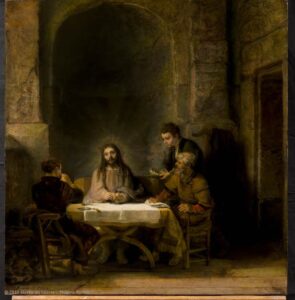
RembrandtThe supper at Emmaus – 1648 – Musée du Louvre  – Corpus ?
Rembrandt Christ at Emmaus – ca. 1628 – 39×42 cm – Musée Jacquemart André in Paris – Corpus A16

Rembrandt made an etching (B 88) and two paintings of the same subject, one now in Musée Jacquemart André in Paris (ca. 1629, Corpus A16, Bredius 539), the other in the Louvre (1648, Bredius 578).
Van Regteren Altena thinks that drawing Benesch A66 was a study for this etching. Based on that he assumed a (first) state that is now lost. Traces of the servant and the chair, as depicted in the drawing, would still be visible in the etching.


Copies

There are two copies in reverse. Copy A is by Georg Leopold Hertel, signed Georg Leop. Hertel exc. A:V (170 x 195 mm, WB 1). Copy B is signed by John Burnet, inscribed Rembrandt f. 1654 (214 x 167 mm, WB 2).


Attributions and reviews

The etching is considered as special by Seidlitz and Coppier.
Boon points at the fact that in two other etchings situated after the death of Christ (B 83 and B 86), the dark tone is dominant, whereas in this etching the light dominates.


States

The New Hollstein lists five states, of which the first two by Rembrandt. The 3rd state (two dots) is ‘new’ . Most other authors list three states, Nowell-Usticke four, from his 3rd state there are later impressions by Watelet, P.F.Basan, Jean, Bernard and Beaumont.
In the 1st state (R284) the drypoint is not yet used. The hat at the right side is not finished. The corners are square. The edges are inky. Early impressions are mainly printed on double-sided thin, Chinese paper.
In the 2nd state the hat is complete. There is much drypoint work added to the curtains, the hat, etc. There are lines on the table under the hand of Christ.
In the 3rd state (NH only) two dots are added in the upper left corner.
In the 4th state (NH/3rd state WB, R285, NU, Watelet, P.Basan, Jean) retouches are made with the burin, possibly by Watelet. Fine, almost horizontal shading is added under the right side of the tablecloth°. The corners are square. In later impressions by Jean the lower corners are rounded. In still later impressions the shading between the feet of Christ is completely reworked.
In the 5th state (NH/4th state NU) Bernard has again reworked the shading with horizontal and diagonal left-to-right lines. The vertical shading on the leg of the table runs to the bottom of the sheet°.


Prints and collections

Of the 1st state many impressions are on Japanese or Chinese paper.
Of the 2nd state all known impressions are on western paper.


Recueils

The etching appears in the Recueil de Basan, impressions quite strong (NU).

B&W 54 – Recueil de Basan – Page 13                   NH: 4th state of V/WB: x state of III.
A good impression, the fine horizontal shading under the table are well visible, the shadow on the left leg not yet extended.

B&W 206 – Recueil de Beaumont –  Sheet 31      NH: 5th and final state/WB: 3rd and final state.
A sharp impression, the vertical lines on the left leg of the table are extended, confirming the final state.


Watermarks

In the 1st state: Posthorn and Strasbourg lily.
In the 2nd state: Strasbourg lily and Foolscap with five-pointed collar (two ed. one c. 1654). Watermarks in later impressions of the 2nd state indicate that the 3rd state is definitely posthumous.
In the 3rd state: Seven Provinces.
In the 4th state: Strasbourg bend, Words and miscellaneous later ones.


Literature

H 282, BB 54-H, G 90, M 237, Mz 233, RA 284-285, Cl 91, W 92, Bl 63, Du 94, CD 239, S 47/48.
Tümpel p. 117;  J.Q. Van Regteren Altena, ‘Rembrandt’s way to Emmaus’, in Kunstmuseets Årsskrift 1949, p. 20 and 23; W.Stechow in Zeitschrift fur Kunstgeschichte N.F. III, 1934, p. 329; Tümpel 2006, p. 89; Hinterding 2008, p. 191-193; Verdi 2014, p. 29-37; Dat kan beter! 2013, p. 38-39; Late Rembrandt 2015, p. 180-185;


Rembrandt in Black & White: 147

New Hollstein: 2nd state of V/White Boon: 2nd state of III
A very good impression with burr on the hat, curtains, figures, table and foliage. The two dots are not yet there, confirming a 2nd state (NH). Some paper support at the edges, verso.
Sheet 211 x 160 mm, no margins, trimmed on the platemark (0%).
Watermark: Foolscap with five-pointed collar, dated ca 1654 (Hinterding 2006, p. 272). Vertical chain lines.


Provenance

In the collection of the German painter and engraver Friedrich Koch (Buxweiler 1771-1835 Mannheim, Lugt 1020), his collector’s mark in black ink verso; The print must have been in the posthumous sales of his collection with either Boerner in Leipzig in 1875 or with Rudolf Bangel in Frankfurt-am-Main in 1889.


Exhibitions

The Rotunda at Exchange Square, Hong Kong, January 2008;
Rembrandt in Zwart-Wit, Stedelijk Museum Zutphen, Museum Gouda, Jan ten Horne Museum (Weert), Stadsmuseum Harderwijk, November 2013-August 2015; Stedelijk Museum Vianen, October 2017 – January 2018;
Rembrandt in Black & White, Schloß Britz (Berlin), Chateau des Penthes (Geneva), November 2015 – October 2016;
Rembrandt, de fotograaf, Westfries Museum (Hoorn), June 2024 – January 2025;