B 88

Christ at Emmaus: the smaller plate

  • French title:
    Les disciples d’ Emaus: petite Emaus
  • German title:
    Christus in Emmaus, klein
  • Dutch title:
    Christus in Emmaus (klein)
  • New Hollstein:
    129
  • Rembrandt in Black & White:
    96

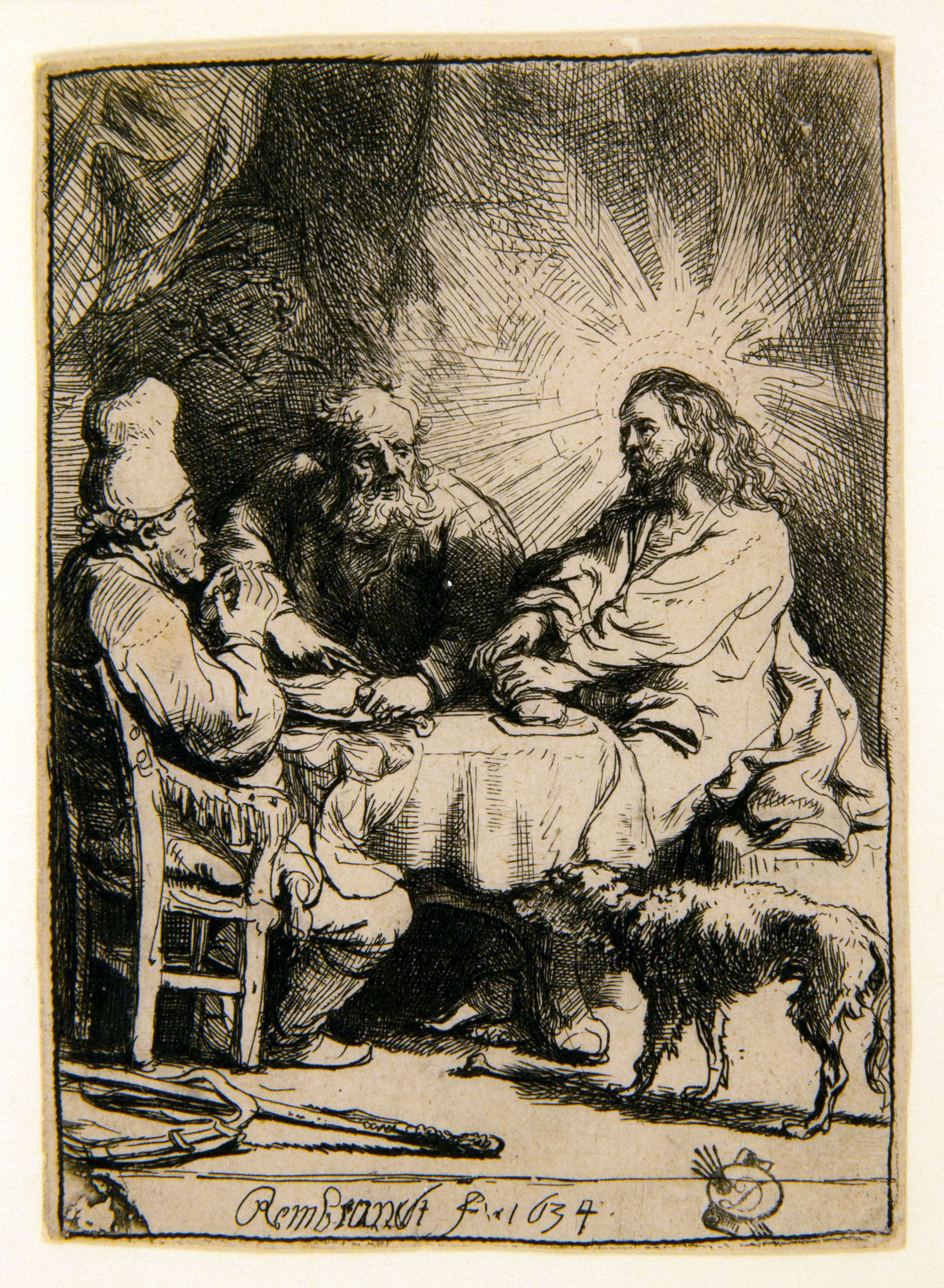
Etching, with some burin and drypoint. 1634.
Size: 102 x 73 mm. Surface: 74 cm2.
Signed and dated, in the lower margin: Rembrandt. f. 1634

NH 129 – Only state

Copper Plate

The plate was not part of any of the early auctions or collections and is probably not in existence.


Rarity of impressions

  • In auctions (2000-2025): common                                                          Early: 27                                        ⦿⦿⦿⊙⊙⊙

  • In collections (New Hollstein 2013): rare                                               Early: 50                                       ⦿⦿⦿⦿⊙⊙

  • Catalogue Nowell-Usticke (1967): R+, a scarce plate                                                                                   ⦿⦿⦿⊙⊙⊙


Story

Luke 24, verses 13-35
His resurrection Christ met with two of his disciples when he was heading for Emmaus. They did not recognize Him until they had dinner and Christ broke the bread.


Picture

In this version, the earlier of two etchings Rembrandt made of this subject, he follows the more traditional habit of showing the moment He breaks the bread. The other etching (B 87) is just a few seconds later, when the disciples recognize Christ. Originally Rembrandt included the servant that is almost always included in pictures about this event, between the two men. He later covered him with crosshatching. In some early impressions his head is still visible.


Animal Farm

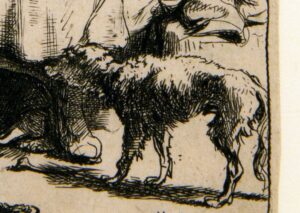
The dog is clearly an important part of the composition. It is looking at the scenery. Maybe hoping that some of the bread will fall of the table.


Inspiration

The composition resembles a drawing by Aertgen van Leyden (now in Berlin).
A picture by D. van Santvoort dated 1633 (now in the Louvre) shows the same scene in reverse.


Related

RembrandtChrist at Emmaus – ca. 1629 – Musée Jacquemart Andrée in Paris – Corpus A16


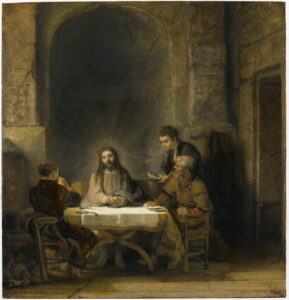
A few years earlier Rembrandt made a painting of the same subject, now in Musée Jacquemart André in Paris (Corpus A16). Much later he made another painting, now in the Louvre (Bredius 578), followed by a another, larger etching (B 87).
RembrandtChrist at Emmaus – 1648 – Musée du Louvre – Corpus


Copies

The New Hollstein lists four copies in reverse. Copy A is by Hertel (two states, 98 x 76 mm); Copy B is by H. Suhrland, inscribed Rembrandt pinx 1634 (85 x 70 mm);
Copies C and D are anonymous (resp. 102 x 72 mm, WB and 95 x 75 mm).


Attributions and reviews

The etching is considered as special by De Claussin and Wilson.
The plate is not by Rembrandt according to Singer.


States

Almost all authors list one state only. Nowell-Usticke lists two states, both contemporary.
The 1st state (NU only) has square corners and some acid spots in the lower left corner.
In the 2nd state (NU only) there are very fine verticals under the chest of the dog. Other authors do not see this as a separate state.


Prints and collections

There are impressions marked P. Mariette 1667 (in Darmstadt and in the National Gallery in Washington).


Watermarks

Double-headed eagle (C. 1632-34); Basel crosier (c. 1634-35); Foolscap.


Literature

H 121, BB 34-K, G 91, M 194, Mz 203, RA 286, Cl 92, W 93, Bl 62, Du 95, Do 86
Van Gelder 1947: p. 33-38; Rembrandt’s passie, p. ; Tümpel 2006, p. 89; Hinterding 2008, p. 194-195; Verdi 2014, p. 29-37;


Rembrandt in Black & White: 96

New Hollstein/White-Boon: only state
Early, dark and richly printed impression.
Sheet 101/103 x 74 mm, thread margins of 1 to 2 mm at the top and both sides, cut at the platemark at the bottom (+1%).
No watermark, horizontal chain lines at approx. 22 mm.


Provenance

In the collection of the English singer and painter Robert Dighton (London 1751-1814, Lugt 727), his collector’s mark in black ink lower right recto; Dighton has a disputed reputation, since he was probably involved in a major theft of prints of the British Museum around 1800.
In the collection of John MacGowan (d 1803, Edinburgh. Lugt 1496), his collector’s mark in black ink verso; It was probably in the posthumous sales of his collection with Scott and Philipe in Edinburgh in May 1803 and January 1804.


Exhibitions

Rembrandt in Zwart-Wit, Stedelijk Museum Zutphen, November 2013 – February 2014;
Rembrandt in Black & White, Schloß Britz (Berlin), Chateau des Penthes (Geneva), November 2015 – October 2016;
Rembrandt, de fotograaf, Westfries Museum (Hoorn), June 2024 – January 2025;