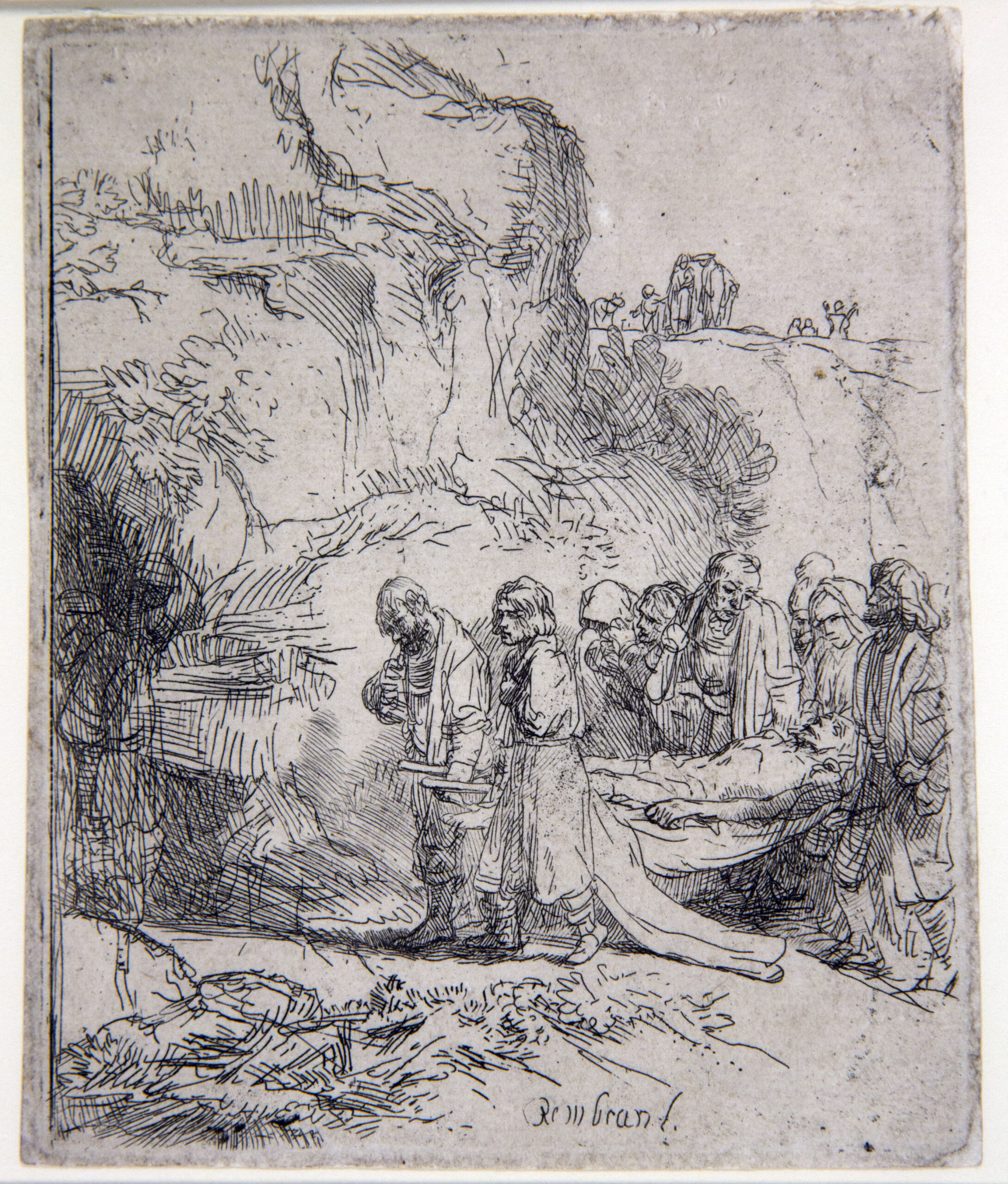
Etching and drypoint. Ca. 1645.
Size: 131 x 108 mm. Surface: 141 cm2.
Signed at the bottom in the centre: Rembrant, not dated. Most authors date this print in 1645, based on the similarity of the signature (ending with ‘t’) but Münz states 1653. He believes that the ‘t’ is actually a ‘d’, but with some foul biting. Hinterding points at the fact that some early impressions are on oriental paper, which Rembrandt used only from 1647 onwards.
The copperplate was part of the sale by Clement De Jonghe (1679 as 35 begraafinge der dooden in’t oude testa) and later in the sale by Pieter De Haan (1767, as lot 29). It was sold to Hendrik de Winter and was later in the sale by Hendrik Busserus (1782, lot 28) where sold to Yver. It is lost since then and is probably not anymore in existence.
Rarity of impressions
In auctions (2000-2025): common Early: 30 ⦿⦿⦿⊙⊙⊙
In collections (New Hollstein 2013): common Early: 64 ⦿⦿⦿⊙⊙⊙
Catalogue Nowell-Usticke (1967): C1-, not uncommon, desirable ⦿⦿⊙⊙⊙⊙
Story
In this etching Rembrandt shows us the story as described in all four Gospels. Surrounded by family and followers, led by Joseph of Arimathea, Christ is taken to the grave He will arise from three days later. Mary is supported by one of the disciples, probably John. Originally, Rembrandt etched one or two figures near the entrance of the cave, but these were covered with hatching later on.
Picture
As the description in the inventory of Clement de Jonghe and later in Valerius Rover’s list in 1731 shows, for a long time this unusual scene was interpreted as the more common portrayed burial of Jacob (Genesis 49, verses 29-33) or as the burial of Lazarus (sales catalogue De Burgy in 1755). But shortly after that the correct identification was used by Gersaint.
Animal Farm
Detail: upper right corner
On the top of the hill a dog is visible, next to a child and his parents.
Inspiration
Tümpel suggests that Rembrandt has used an engraving by Giovanni Battista (c. 1510-1561) as an example.
Related
A drawing, the Entombment, (HdG 225, now in Dresden) shows a similar arrangement of the landscape. Valentiner has pointed out that the nearest bearer resembles Titus. There is also a similarity with the angel in Abraham’s sacrifice (B29), dated in 1655, for whom Titus was also used as a model, according to Valentiner.
Copies
New Hollstein lists four copies, of which only one (C) in the same direction. It is anonymous, signed Rembrandt in. (128 x 105 mm).
There are three copies in reverse. Copy A is by Francesco Novelli (two states, his nr 23, 129 x 106, WB 2). Copy B is anonymous, signed Rembrand in f. (127 x 103 mm, WB 3). Copy D is signed Rembrand in f. John Burnett (129 x 105, WB 4).
Attributions and reviews
The etching is considered as special by Coppier and De Claussin.
States
All authors list one state only. Early impressions show burr in the left foreground and on the stretcher. Later impressions are rather greyish.
Prints and collections
There are counterproofs in the Rijksmuseum and the British Museum.
There are various impressions on Chinese and Japanese paper.
Watermarks
Arms of Amsterdam and Bristol, Foolscap with seven-pointed collar and Paschal lamb, all dated 1651.
Literature
H 215, BB 45-3, G 88, M 217, Mz 224, RA 271, Cl 88, W 89, Bl 60, Du 92, CD 167 Hinterding 2008, p. 185ff;
Rembrandt in Black & White: 98
New Hollstein/White-Boon: only state
A good, evenly printed impression with strong contrasts.
Sheet 136 x 112/114 mm, margins of 1 to 3 mm all around (+9%).
Unidentified watermark, vertical chain lines at approx. 8 mm.
Exhibitions
Rembrandt in Zwart-Wit, Stedelijk Museum Zutphen, November 2013 – February 2014; Rembrandt in Black & White, Chateau des Penthes (Geneva), June-October 2016; Rembrandt, de fotograaf, Westfries Museum (Hoorn), June 2024 – January 2025;