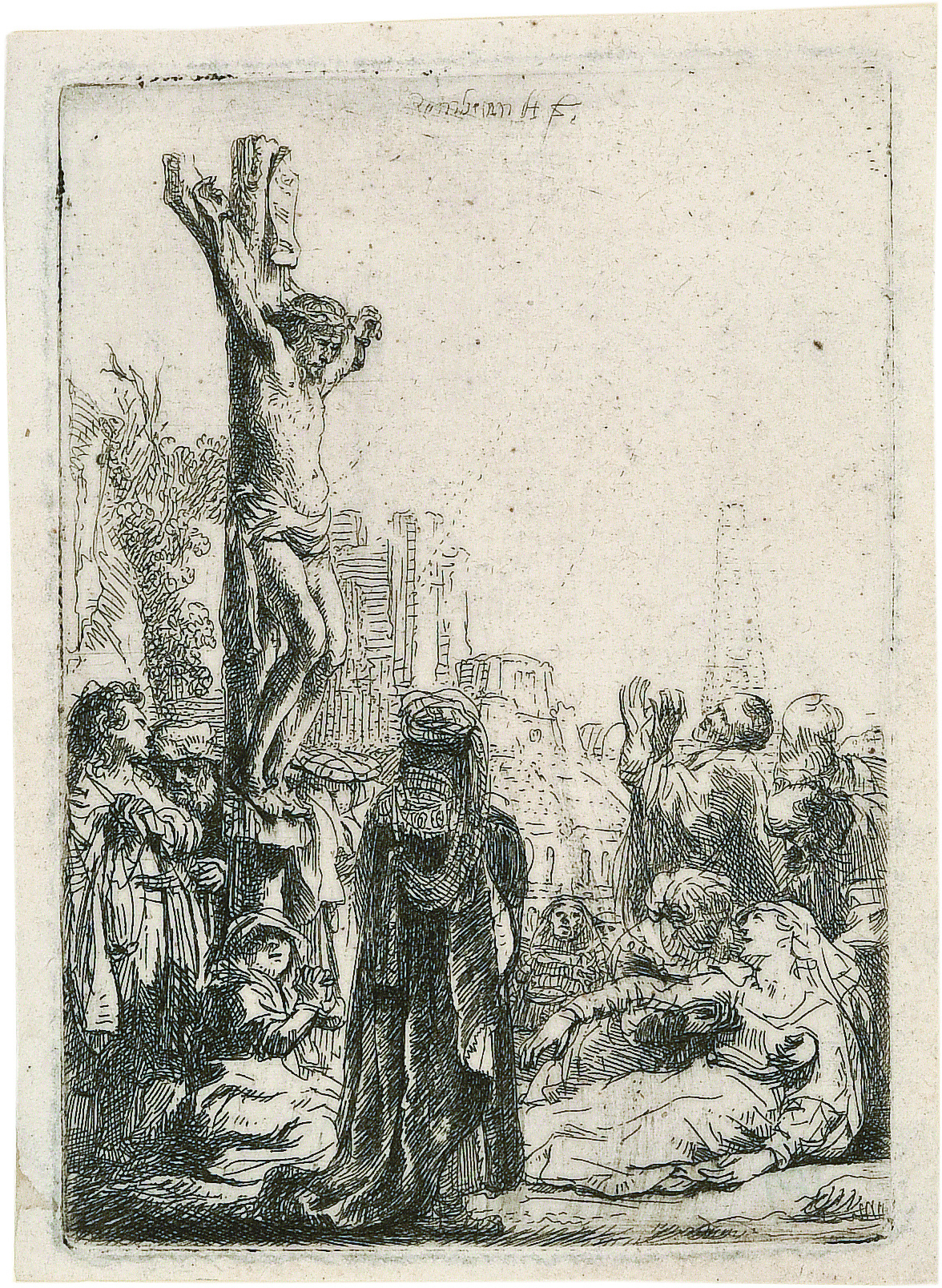
The copperplate was in the sale by Jean de Bary (1759, lot 49) and sold to Ottens. It was then in the collection of Claude-Henri Watelet (1718-1786) and became part of the set of plates subsequently owned and used for printing Recueils by Pierre-François Basan (1723-1797), Henri-Louis Basan (his nr 1397), Auguste Jean (ca 1809), Veuve Jean, Auguste and Michel Bernard (1846), Alvin-Beaumont (1906) and Robert Lee Humber (1937). It was sold at the Artemis sale in London (1993) and is now in a private collection in the USA.
Rarity of impressions
In auctions (2000-2025): frequent Early: 47 Late: 6 ⦿⊙⊙⊙⊙⊙
In collections (New Hollstein 2013): very frequent Early: 84 Late: 4 ⦿⊙⊙⊙⊙⊙
Catalogue Nowell-Usticke (1967): C2-, a common, very attractive little print ⦿⊙⊙⊙⊙⊙
Picture
The first of three prints on the subject of the crucifixion is the smallest of the three, leaving out the two other crosses. It is not clear if Jesus had already died or if he is still alive, exchanging a final view with His Mother, who is supported by His favourite disciple John. It may well be that this is the moment as described in John 19, verses 26-27 when Jesus asks His Mother to consider John as her son. Mary Magdalena is seen at the foot of the cross.
Inspiration
A woodcut by Hans Sebald Beham (Pauli 824) may have served as a prototype (Münz). Broos also pointed at Calvary, a woodcut by Albrecht Altdorfer (B 30, 1480-1538).
An engraving by Lucas van Leyden (1494-1533) could be the inspiration for the positioning of Mary and even Christ. Boon saw a similarity in the figure of Mary with a painting (Corpus C49, in the Hermitage) but that work is no longer attributed to Rembrandt.
Related
There is a similar drawing, in reverse (HdG 1558, in the National Museum in Stockholm).
A drawing in the Kupferstichkabinett in Berlin (Benesch 108) could have been a preparatory work, but the drawing is now attributed to his pupil Gerbrand van den Eeckhout. NH suggests that this drawing is made after the etching.
Copies
The New Hollstein lists three copies of which two in the same direction. Copy B is by John Frederick Lewis, inscribed Rembrandt f (114 x 85 mm, WB 1). Copy C is anonymous, signed REMBRANNK (WB 2, not traced by NHD)
There is one anonymous copy in reverse, copy A, inscribed Rembran c. 1631 (two states, 99 x 70 mm, WB 3).
Attributions and reviews
The etching is considered as special by Coppier.
States
The New Hollstein lists three states, only the first by Rembrandt. Most other authors list one state only. Nowell-Usticke lists four states, from the intermediate prints of the 1st state there are impressions by Watelet, P.Basan, Basan, Jean, Bernard and Beaumont.
In the early prints of the 1st state (NH, WB only, NU) the signature is clearly visible, with some horizontal scratches through the letters Rem. The shading in the back of Jesus is sharp and clear. In intermediate and later impressions of the 1st state (NU, P.Basan, Basan, Jean) the signature becomes weak and sometimes invisible. The shading on the back of the standing man becomes weaker.
In the 2nd state (NHD, NU, Jean) new shading is added, especially on the cloak of the man standing in the foreground° and the top of the cross. The break in the outline of Jesus’ stomach is closed (NU). Several black spots appear around and to the right of Jesus’ head (NU).
In the 3rd state (NU, Bernard, still 2nd state NHD) the cloak of the standing man is retouched with vertical and left-to-right diagonals. The signature is almost invisible. The black spots around the head of Jesus are erased.
In the 3rd state (NHD, 4th state NU, Bernard) a lot of new work is added. Additional horizontals lines are added to the four long verticals under Jesus’ armpit. There is fine crosshatching down the back of Jesus.
Prints and collections
There is an impression on Japanese paper in the British Museum. It has a mezzotint effect, achieved by leaving ink on the surface of the plate while printing. This technique was frequently used by Rembrandt after 1650, but only rarely in earlier periods, leaving Münz to conclude that this is not Rembrandt’s work.
An impression of the 1st state in the Rijksmuseum is printed on an uncut quarto sheet, leaving exceptionally large margins.
There is a counterproof in the Fitzwilliam Museum (Cambridge UK).
Recueils
The etching appears unchanged in the Recueil de Basan, impressions fair (NU).
B&W 54 – Recueil de Basan – Page 10 NH: 2nd state of III/WB: only state.
A weak impression, the signature is no longer visible, but before the additional shading in later states.
B&W 206 – Recueil de Beaumont – Sheet 28 NH: 3rd and final state/WB: only state.
A stronger impression than the one in the Recueil de Basan. The white part on the left side of the cloak of the man in front confirms a 3rd and final state.
Watermarks
In the 1st state: Strasbourg Lily with BA (2 ed., 1635); Paschal lamb.
Literature
H 123, BB 35-1, G 82, M 193, Mz 202, RA 263, Cl 85, W 86, Bl 55, Du 87, CD 89 Hinterding 2006, p. 268; Hinterding 2008, p. 176-178;
Rembrandt in Black & White: 209
New Hollstein: 1st state of III/White-Boon: only state
A very good, early impression with some plate tone.
Sheet 101/103 x 75 mm, broad margins of approx. 3 mm all around (+20%).
Proprietary watermark, horizontal chain lines at approx. 25 mm.
Provenance
In the collection of Paul Davidsohn (1839-1931, Berlin Grunewald, Lugt 654), his collector’s mark in black ink verso; His collection sold with C.G. Boerner in Leipzig in April 1920 (lot 74).
In a private collection, collector’s mark P in a house-shaped frame in black ink (not in Lugt) verso;
Exhibitions
Rembrandt, de fotograaf, Westfries Museum (Hoorn), June 2024 – January 2025;