Etching. 1630.
Size: 108 x 78, from the 3rd state 89 x 66 mm. Surface: 86 cm2 from the 3rd state 59 cm2.
Signed with a monogram and dated (in the 1st and 2nd state) in the lower middle margin: RHL. 1630
The plate was probably in the collection of Clement de Jonghe (1679, as 46 Christus jongh sijnd en disputerend). The next, anonymous owner added two dots (ca. 1700). It later appeared in the sale of Pieter de Haan (1767, lot 21). It was sold via Fouquet to Claude-Henri Watelet (1718-1786). It then became part of the set of plates subsequently owned and used for printing Recueils by Pierre-François Basan (1723-1797), Henri-Louis Basan (his nr 1389), Auguste Jean (ca 1809), Veuve Jean, Auguste and Michel Bernard (1846). It was then in the collection of Alfred Strölin (Lausanne) and sold, between 1922 and 1932, to I. de Bruijn and J.G. de Bruijn – van der Leeuw (Muri, Switzerland). Since 1961 the plate is lost.
Rarity of impressions
In auctions (2000-2025): common Early: 5 Late: 12 ⦿⦿⦿⊙⊙⊙
In collections (New Hollstein 2013): frequent Early: 50 Late: 21 ⦿⦿⊙⊙⊙⊙
Luke 2: 41-52
This is the earliest of four etchings Rembrandt made of this subject. The other three (B60, B64 and B65) were made more than twenty years later. It shows the moment when Christ, at the age of twelve, travelled to Jerusalem with his parents for Easter and was left behind when they returned. He was found three days later, among the teachers in the temple, in discussion with them.
Picture
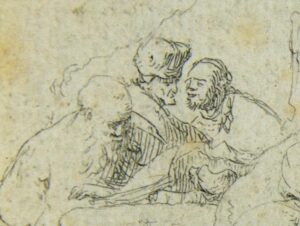
NH 53 – B 66 – Detail
In this print Rembrandt shows us the moment when Mary and Joseph are entering the temple to find their lost Son.
The large structure on the right side suggests that we are in the temple.
In the background we see three scholars in a conversation, obviously still somewhat impressed by the ‘lessons’ of the 12-year old boy.
Related
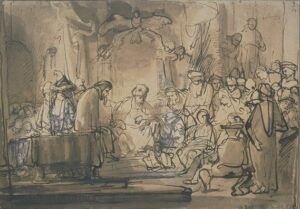
Rembrandt – Christ among the doctors – ca. 1652 – 189 x 259 mm – Musée du Louvre – Benesch 885
Rembrandt made two drawings of the same subject probably about the same time that he made the three later etchings (Benesch 936, now at the Nationalmuseum in Stockholm and Benesch 885, now in the Louvre). A year earlier Rembrandt made a painting Judas repentant, returning the thirty pieces of silver (Corpus A15, Bredius 539a, now in a private collection in the UK) which shows a similar composition.
Copies
There is a copy in reverse by Francesco Novelli (three states, his nr 16, 97 x 77 mm, WB).
Attributions and reviews
The plate was made by a pupil according to Coppier. The plate is not by Rembrandt according to Singer.
States
The New Hollstein lists seven states, the final three not by Rembrandt. The 5th state (two dots) is ‘new’. Most other authors list three states, Nowell-Usticke six, from his 4th state there are later impressions by P.Basan, H.Basan, Jean, Bernard and Beaumont.
The 1st state (NH, WB, R211) shows the face and shoulder of the seated figure at right unshaded.
In the 2nd state (NHD, WB, R212) this face is now completely shaded.
In the 3rd state (NH, NU) the plate is cut down to 89 x 66 mm, cutting off the signature. Two other little figures are added behind the table. The corners are square.
In the 4th state (NH/3rd state WB final, R213) the corners are rounded and there is crosshatching below the balcony.
In the 5th state (NH only) two dots are added in the upper right corner by a later owner.
In the 6th state (NH/4th state NU, Basan) the plate is subtly reworked, mainly in the lower left corner. Like the shading under the man in the centre. In later impressions there is a long vertical scratch to the left of Christ, starting up from the foot of the man seated in the centre.
In the 7th state (NH/5th state NU, Jean) the plate is complete reworked.
The 6th state (NU, Bernard) is very poorly retouched (by Bernard?). The fine shading is worn out.
Prints and collections
Of both the 1st and 2nd state only five impressions are known.
The etching appears in the Recueil de Basan, impressions good (NU).
Recueils
B&W 54 – Recueil de Basan – Page 20 NH: 6th state of VII/WB: 3rd and final state
A weak impression. The two dots are clearly visible, the scratch is not.
B&W 206 – Recueil de Beaumont – not included
Watermarks
In the 1st state: Eagle with Basel crosier (1630).
In the 3rd state: Basilisk (c. 1632).
Literature
H 20, BB 30-D, G 65, M 177, Mz 190, RA 210-214, Cl 70, W 70, Bl 37, Du 69, CD 18 Rembrandt creates Rembrandt, p. 102-103; Rembrandts passie, p. 84-85; Hinterding 2006, p. 261 Hinterding 2008, p. 138-140; Verdi, p. 86-87 ;
Rembrandt in Black & White: 184
New Hollstein: 4th state of VII/White-Boon: 3rd and final state.
A thinly printed impression on laid paper of the last state made by Rembrandt, before the two dots of the 5th state.
Sheet 88 x 68 mm, cut on the platemark at left, margins of approx. 1 mm at the other sides (+2%).
Part of an unidentified watermark (grapes?), horizontal chain lines at approx. 24 mm.
Exhibitions
Rembrandt in Black & White: Schloß Britz (Berlin), Chateau des Penthes (Geneva), November 2015 – October 2016;