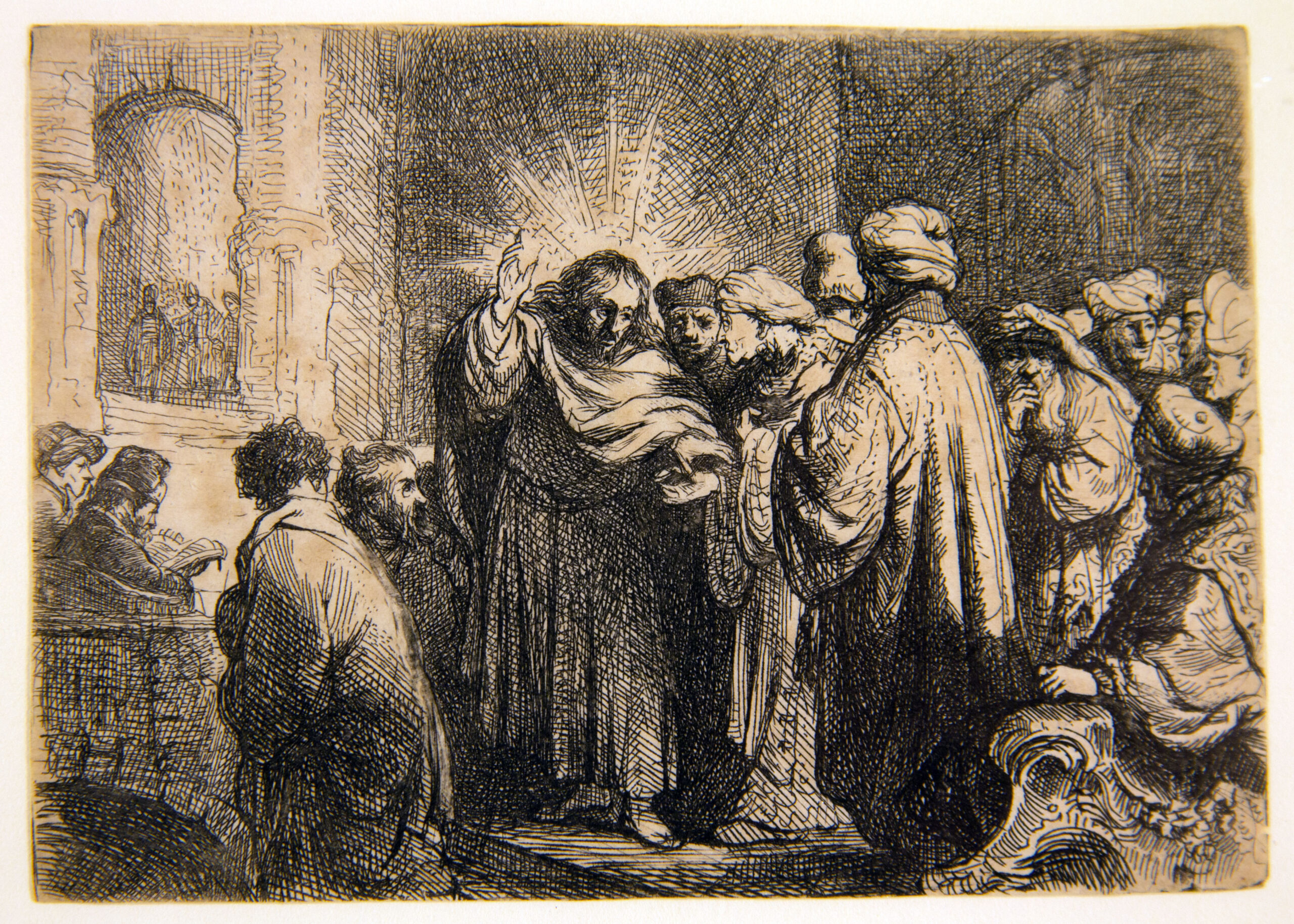
Etching, drypoint and burin. Ca. 1634.
Size: 73 x 103 mm. Surface: 75 cm2.
Not signed, not dated. Date assumed 1635 by Biörklund, 1634 by Hind, Middleton, Münz and Hinterding. Watermark research supports this earlier date.
The copperplate was in the sale of Pieter de Haan (1767, lot 23) and was sold via Fouquet to Claude-Henri Watelet (1718-1786). It then became part of the set of plates subsequently owned and used for printing Recueils by Pierre-François Basan (1723-1797), Henri-Louis Basan (his nr 1390), Auguste Jean (ca 1809), Veuve Jean, Auguste and Michel Bernard (1846), Alvin-Beaumont (1906) and Robert Lee Humber (1937). It was sold at the Artemis sale in London (1993). It was first with Noortman Master Paintings (Maastricht 2007), then in a private collection in the UK.
Rarity of impressions
In auctions (2000-2025): very frequent Early: 16 Late: 45 ⦿⊙⊙⊙⊙⊙
In collections (New Hollstein 2013): frequent Early: 39 Late: 40 ⦿⦿⊙⊙⊙⊙
Catalogue Nowell-Usticke (1967): C2, fairly common ⦿⊙⊙⊙⊙⊙
Story
Matthew 22, verses 15-22
After Jesus had driven the money-changers out of the temple, as pictured in B69, the Pharisees try to corner Jesus by asking him whether it is allowed under Jewish law to pay taxes to the Romans. The etching depicts the moment when Jesus in return asks for a tribute coin. He asks them who is pictured on the coin. When the Pharisees identify these as being Caesar’s Jesus tells them “Give Caesar what belongs to him and to God what belongs to God”.
Picture
Traditionally this scene is pictured in the open air, but Rembrandt follows the Script by placing it inside the temple. Despite all the turmoil one of the two men on the left continues reading a book. Strangely enough, a real coin is nowhere to be seen.
Related
A painting in reverse of 1629 (C7, Bredius 536), now in the National Gallery of Canada (Ottawa), was often quoted as an example, but this painting is no longer considered to be by Rembrandt.
Münz mentions an etching by Simon Frisius after Hendrik Hondius.
Copies
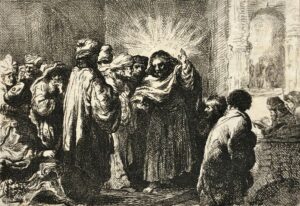
B&W 343 – Francesco Novelli – The tribute money – Copy D of NH 138 / B 68 in reverse
NH lists four anonymous copies in the same direction. Copy B is signed R. (71 x 110 mm, W 1). Copy E is signed Rembrandt in (78 x 106 mm, WB 2). Copies C and F are not signed (resp. 72 x 103 mm and 73 x 105 mm, WB 4).
There are five copies in reverse. Copy A is by Conrad Meyer (110 x 150 mm).
Copy D is by Francesco Novelli and is included in the collection ”Rembrandt in B&W”, nr 343 (three states, his nr 19, 88 x 126 mm, WB 3).
Copy F and G are anonymous (resp. 73 x 105 mm, 75 x 103 mm, both possibly WB 4). Copy I is also anonymous (80 x 120 mm).
Attributions and reviews
The etching is considered as special by Bartsch, De Claussin and Wilson.
The plate is not by Rembrandt according to Singer.
States
The New Hollstein lists four states, only the first by Rembrandt. Most other authors list two states, Nowell-Usticke three, from his 2nd state there are later impressions by Watelet, P.Basan, Jean, Bernard and Beaumont.
Early impressions of the 1st state (NH, WB, R217, NU) show burr on the back of the standing man at left.
In the 2nd state (NH, WB final, R218, NU) the dark shadows are reworked with fine shading, mostly with a rocker. Like between the outstretched hand and the head of Jesus and six fine lines above the centre of Christ’s head°. Hinterding considers this state to be a ‘repair state’, not by Rembrandt.
In the 3rd state (NH, NU Bernard?) the entire plate is retouched. The vertical lines on the turban are no longer visible. Horizontal and vertical cross-hatching is added to the background behind Christ.
In the 4th state (NH only) the plate is reworked again. Diagonals and curved horizontals added behind Christ near the upper margin. Diagonals added to the robe of Christ above the waistband and on the back of the reading man, left. There are new verticals on the back of his chair. Diagonals are added to the upper right margin.
Prints and collections
There is an impression on Japanese paper in the Lugt Collection, according to Hinterding by later printers.
An impression in red ink in the Fitzwilliam Museum (Cambridge UK).
Recueils
The etching appears in the Recueil de Basan, impressions very good (NU).
B&W 54 – Recueil de Basan – Page 19 NH: 2nd state of IV/WB: 2nd and final state
A rather good impression, the rocker lines clearly visible.
B&W 206 – Recueil de Beaumont – Sheet 21 NH: 4th and final state/WB: 2nd and final state
A dark impression, showing the result of too much rework.
Watermarks
In the 1st state: Basel crosier (c. 1634-35); Foolscap with five-pointed collar (2 ed.).
Literature
H 124, BB 35-2, G 67, M 196, Mz 200, RA 217-218, Cl 72, W 72, Bl 42, Du 81, CD 88 Rembrandts Passie, p. ?; Hinterding 2008, p. 143-144; Rijke traditie, p. 67;
Rembrandt in Black & White: 109
New Hollstein: 1st state of IV/White-Boon: 1st state of II
A good, contemporary impression. A small weak spot in the middle, not visible recto. The burr on the back of the standing man at left is clearly visible, before the mezzotint rocker additions near the head of Christ, indicating a 1st state (NH).
Sheet 72 x 101/102 mm, cut at or inside the platemark (-2%).
No watermark, vertical chain lines at approx. 24 mm.
Exhibitions
Rembrandt in Zwart-Wit, Stedelijk Museum Zutphen, November 2013-February 2014; Rembrandt, de fotograaf, Westfries Museum (Hoorn), June 2024 – January 2025;