Etching and drypoint. 1650.
Size: 82 x 172 mm. Surface: 145 cm2.
Signed and dated, in the lower left margin: Rembrandt. f. 1650 The last number is difficult to discern and is sometimes read as ‘52’. Watermark research supports the dating to 1650.
The copperplate was not in any of the early sales or collections and is probably not in existence.
Rarity of impressions
In auctions (2000-2025): very rare Early: 8 ⦿⦿⦿⦿⦿⊙
In collections (New Hollstein – 2013): common Early: 64 ⦿⦿⦿⊙⊙⊙
Catalogue Nowell-Usticke (1967): R+, a scarce, attractive arched print ⦿⦿⦿⊙⊙⊙
Subject/Sitter
This print was earlier known as Landscape with a haybarn and a flock of sheep until Lugt noticed that it was the same cottage as in B213 and White-Boon later suggested that the view was taken (in reverse) from the Diemerdijk, between Houtemael and Zeeburg. According to Bakker (1998) and Hinterding the skyline to the right of the house shows the church of Ouderkerk, the inn Het Molentje on the Amstel and the spire of Amstelveen.
Animal Farm
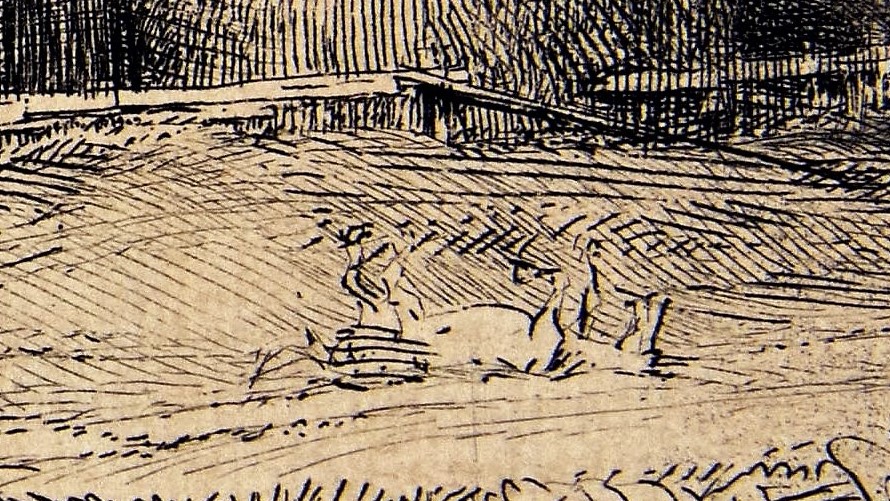
The most striking aspect of this print was already noted in 1755 when the description for the de Burgy sale read: Een Landschapje, met een Boerenwooning en een Hooischuur, waarin een Paard op den Rug legt (Landscape with a farmhouse and haystack, in which a horse is lying on its back).
Related
There is a drawing with a similar subject (Benesch 1226, now in the Ashmolean Museum in Oxford) which may have served as preparation for the execution of the etching in the studio. The same applies to a drawing in which a horse on his back is shown (Benesch 1225, now in the Groninger Museum). If it is authentic it may have served as a preliminary study.
Copies
There is one copy (C) in the same direction by Captain William Baillie inscribed Rembrandt f. 1636 (three states, 88 x 175 mm, WB 1)
There are three copies in reverse. Copy A is by Francis Vivares, with a rounded top, inscribed Rembrandt 1636, the 6’s reversed (1758, his nr 1, 89 x 175 mm, WB 3).
Copy B is by Claude Henri Watelet (98 x 184 mm, WB 2). Copy D is by Louis Gervais Marvy, signed Louis Marvy d’apres Rembrandt (111 x 211 mm, WB 4).
Attributions and reviews
The etching is considered as special by Bartsch, Coppier, De Claussin and Wilson.
States
All authors list two states, both contemporary.
In the 2nd state a distant horizon is added at the left and a dead branch is added at the left of the trees in the centre.
Seidlitz is the only author to think that this state is not by Rembrandt.
Prints and collections
Of the 1st state eight impressions are known, five of which are printed on Japanese paper.
Of the 2nd state there are also impressions on Japanese and oatmeal paper.
No posthumous impressions are known.
Watermarks
In the 1st and 2nd state: Foolscap.
In the 2nd state: Arms of Amsterdam with cm IFD; Posthorn with IR; Strasbourg lily.
Literature
H 241, BB 52-A, G 216, M 319, Mz 159, RA 606-608, Cl 221, W 221, Bl 325, Du 221, CD 200, S 101. Wandelingen 1998, p. 219-226; Hinterding 2008, p. 419-422;
Rembrandt in Black & White: 156
NH/WB: 2nd and final state
A good, contemporary impression.
Sheet (arched) 84/83 x 180/179 mm, margins of 1 to 2 mm at some places, cut at the platemark elsewhere (+7%).
No watermark, horizontal chain lines at approx.. 24 mm,
Exhibitions
Rembrandt in Zwart-Wit, Het Markiezenhof (Bergen op Zoom), Jan ten Horne Museum (Weert), Stadsmuseum Harderwijk, March 2013-August 2015; Stedelijk Museum Vianen, October 2017 – January 2018; Rembrandt in Black & White, Bozar Expo – Brussels March-June 2016; Rembrandt: Paysages, Fonds Glenat (Couvent Ste.Cecile – Grenoble), February – June 2023; Rembrandt, 17th century photographer, Daegu Art Museum (Korea), November 2023 – March 2024; Rembrandt, de fotograaf, Westfries Museum (Hoorn), June 2024 – January 2025;