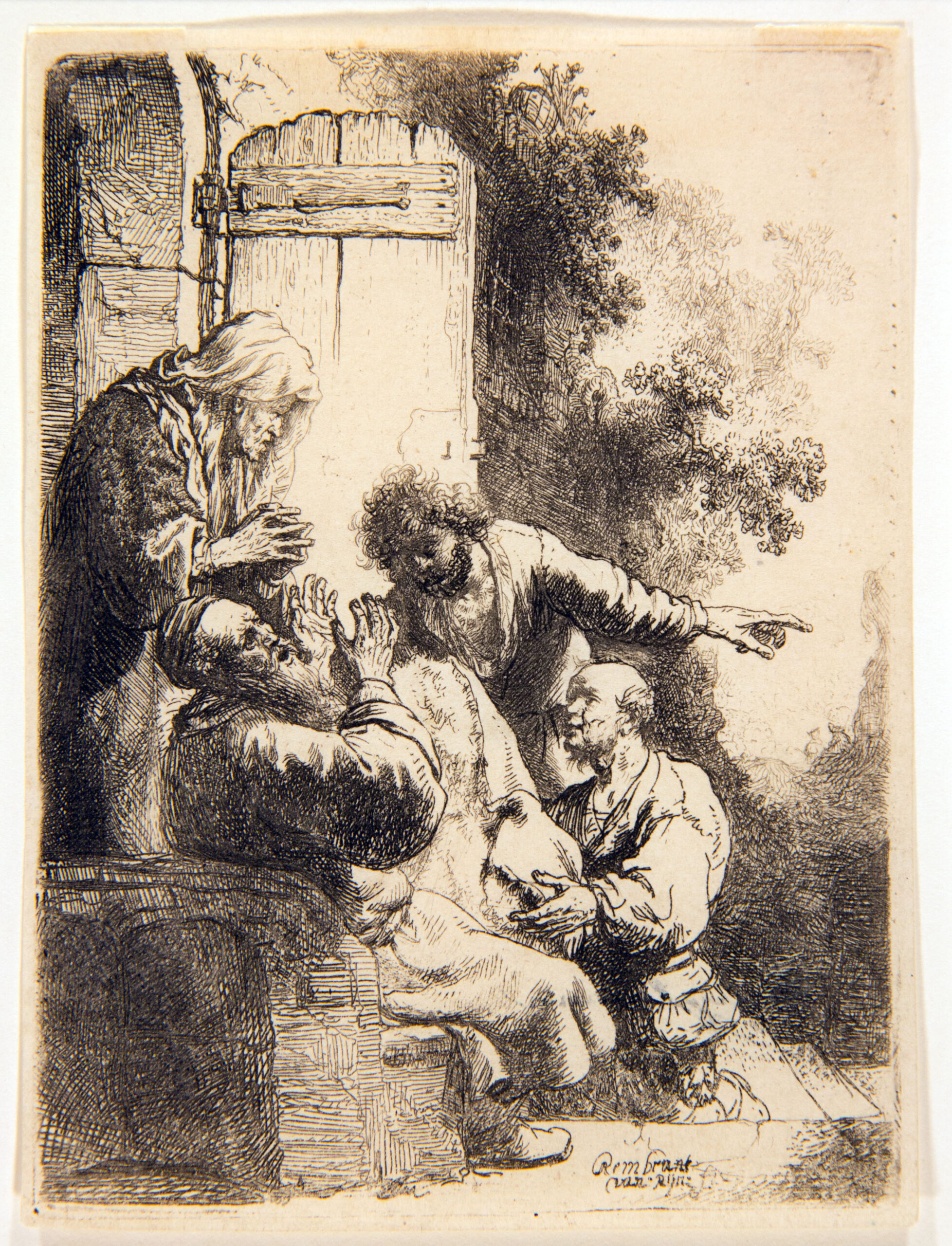
Etching with touches of drypoint. Ca. 1633.
Size: 107 x 80 mm. Surface: 86 cm2.
Signed in the bottom right corner: Rembrandt/ van.Ryn. fe. Rembrandt started to sign with his full name in 1632/33.
Not dated. According to Münz the plate dates from 1629 and was later (1632/33) reworked by pupils under Rembrandts supervision. Hind reads 1633 in the lower right corner beneath the shadow.
The copperplate was in the auction of Pieter de Haan (1767, lot 7) and sold to J.Sluyter. It was later acquired by John McCreery (c 1816) and used for printing the 200 Etchings and then reprinted by W.Lewis (1822) and L.Kay (1826). It is probably not anymore in existence.
Rarity of impressions
In auctions (2000-2025): frequent Early: 7 Late: 26 ⦿⦿⊙⊙⊙⊙
In collections (New Hollstein 2013): common Early: 25 Late: 35 ⦿⦿⦿⊙⊙⊙
Nowell-Usticke (1967): R-, an uncommon small print ⦿⦿⦿⊙⊙⊙
Story
Genesis 37, verses 18-34
Jacob’s youngest son Joseph was sold as a slave by his brothers. They drenched his coat in blood and showed it to his father as if they found the coat in the desert. Jacob recognizes the coat as belonging to Joseph and concludes that his favourite son must have been fallen victim to wild animals. He fell into a deep depression.
Picture
The gesture of the pointing hand and the emptiness on the right side of the plate provide a lot of dynamics to this plate. The two men holding the coat could be the brothers, but they could also be some messengers. In that case the two men in the background could be the sons. Or are they the merchants Joseph was sold to. Could the purse of the kneeling man be filled with cash from the sale?
Related
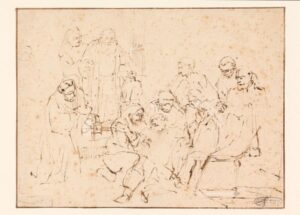
Rembrandt – Joseph’s coat brought to Jacob – ca 1655 – 133 x 179 mm – Boymans van Beuningen – Benesch 991
A drawing in the Boijmans van Beuningen (Benesch 991) shows the same subject.
Münz points at the similarity between Jacob’s wife and the old woman in B165 (Beggar man and woman behind a bank) and between Jacob’s head with that of other old men etched by Rembrandt before 1630 (e.g. B 153).
Some authors see likeliness between the brother pointing his finger and the self-portrait with long bushy hair (B8).
Hinterding points at a drawing in Berlin (Benesch 95) which shows a similar gesture opf despair as Jacod is showing. It is dated somewhat later and may be made after the etching.
Peter van der Coelen has suggested that the limited number of brothers is reminiscent of works by Lucas van Leyden and Antonio Tempesta.
Copies
The New Hollstein lists no less than twelve copies, of which four in the same direction. Copy C is by David Deuchar (105 x 106 mm, WB 1). Copy D is by Charles George Lewis, signed Rembrandt | van Ryn fec (108 x 83 mm, WB 2). Copy E is by Le Sueur (126 x 105 mm, WB 4). Copy B is an anonymous one (108 x 83 mm, WB 3).
There eight copies in reverse. Copy G is by Charles Michel Campion inscribed Rembrand Delin (123 x 80 mm, WB 6). Copy J is signed R (Richard) Cooper (103 x 81 mm, WB 8), Copy K is by Johann Georg Hertel, inscribed Rembrandt fec. (his nr. 30, 104 x 81 mm). There are also two woodcuts and two anonymous copies.
Attributions and reviews
The etching is considered as special by Bartsch, De Claussin and Wilson.
The plate was made by a pupil according to Middleton and von Seidlitz (they suggested van Vliet). Münz thinks that assistants played a role in completing the plate.
The plate is not by Rembrandt according to Vosmaer, Rovinski and Singer.
States
The New Hollstein, as most authors, lists two states, only the first by Rembrandt. Nowell-Usticke lists four states, from his 2nd state there are later impressions by Watelet.
In the 1st state (NH, WB, R135, NU) there appears to be a tiny break in the top outline of the skull of the kneeling man. The pointing man’s thumb has a second, longer, faint thumb below. The stone seat appears to be in one piece, the back quite light. Almost square corners (NU). In later impressions there is a long diagonal right to left stroke about 2 mm right of the right edge of Jacob’s sleeve.
In the 2nd state (NH, WB, R134, NU Watelet?) fine diagonal shading is added in the centre of the curved top of the dark area beneath Jacob’s seat (WB/BB). Shadow added to the back of the bench. A fine line is added to cover the break mentioned above, giving the skull a more rounded appearance. A group of right to left diagonals added to the right of the patch of shading above the middle of the seat (NU). Hinterding concludes that these alterations were made to restore the original contrasts, almost certainly not by Rembrandt.
In the 3rd state (NU) the plate is rebitten. There is a heavy outline to the kneeling man’s skull.
In the 4th state (NU) there is rough retouch work in the worn spots on the back of the seat and the lower portion of Leah’s robe. Nowell-Usticke thinks there may be an even later state, based on Rovinsky’ s 2nd illustration.
Prints and collections
There is a counterproof of the 1st state in the British Museum. Two impressions of the 1st state in the Dutuit collection (Paris) are marked P.Mariette 1670 and P.Mariette 1674, which indicates that the 2nd state is posthumous.
There is a counterproof of the 2nd state in Philadelphia. There is an impression in the 200 Etchings (1816), but not in the Recueils.
Watermarks
In the 1st state: Arms of France; Seven Provinces; Strasbourg Lily.
In the 2nd state: Posthorn; Strasbourg lily; Several other, later ones.
Literature
H 104, BB 33-1, G 35, M 189, Mz 172, RA 134-135, Cl 42, W 42, Bl 10, Du 42, CD 75. Tümpel 2006, p. 36; Spijkerboer 2006, p. 68; Hinterding 2006, p. 251; Hinterding 2008, p. 89; Rosenberg 2017, p. 110.
Rembrandt in Black & White: 67
New Hollstein/ White-Boon: 2nd and final state.
A fair, probably later impression on thin laid paper. Considering that the extra line in the skull of the kneeling man is not visible, it is probably also a 2nd state of Nowell-Usticke. There is some wear in the deeper shadows, like in the tree top in the middle. Verso an area of thin paper in the centre where the remains of an oval collector’s stamp (removed?) are visible. Not visible recto.
Sheet 110/111 x 81/83 mm, narrow margins of 1 mm all around (+6%).
No watermark, vertical chain lines at approx. 25 mm.
Provenance
In the collection Henzelmann, his stamp in black ink verso (not in Lugt), vaguely visible recto.
Exhibitions
Rembrandt in Zwart-Wit, Museum Gouda, July – October 2014; Rembrandt, de fotograaf, Westfries Museum (Hoorn), June 2024 – January 2025;