
B 40

The triumph of Mordecai

  • French title:
    Le triomphe de Mardochee
  • German title:
    Der Triumph des Mardochaus
  • Dutch title:
    De triomf van Mordechai
  • New Hollstein:
    185
  • Rembrandt in Black & White:
    165

Etching and drypoint. Ca. 1641.
Size: 174 x 215 mm. Surface: 374 cm2.
Not signed, not dated. Middleton states 1651, Seidlitz and Hind 1640, Benesch 1641.

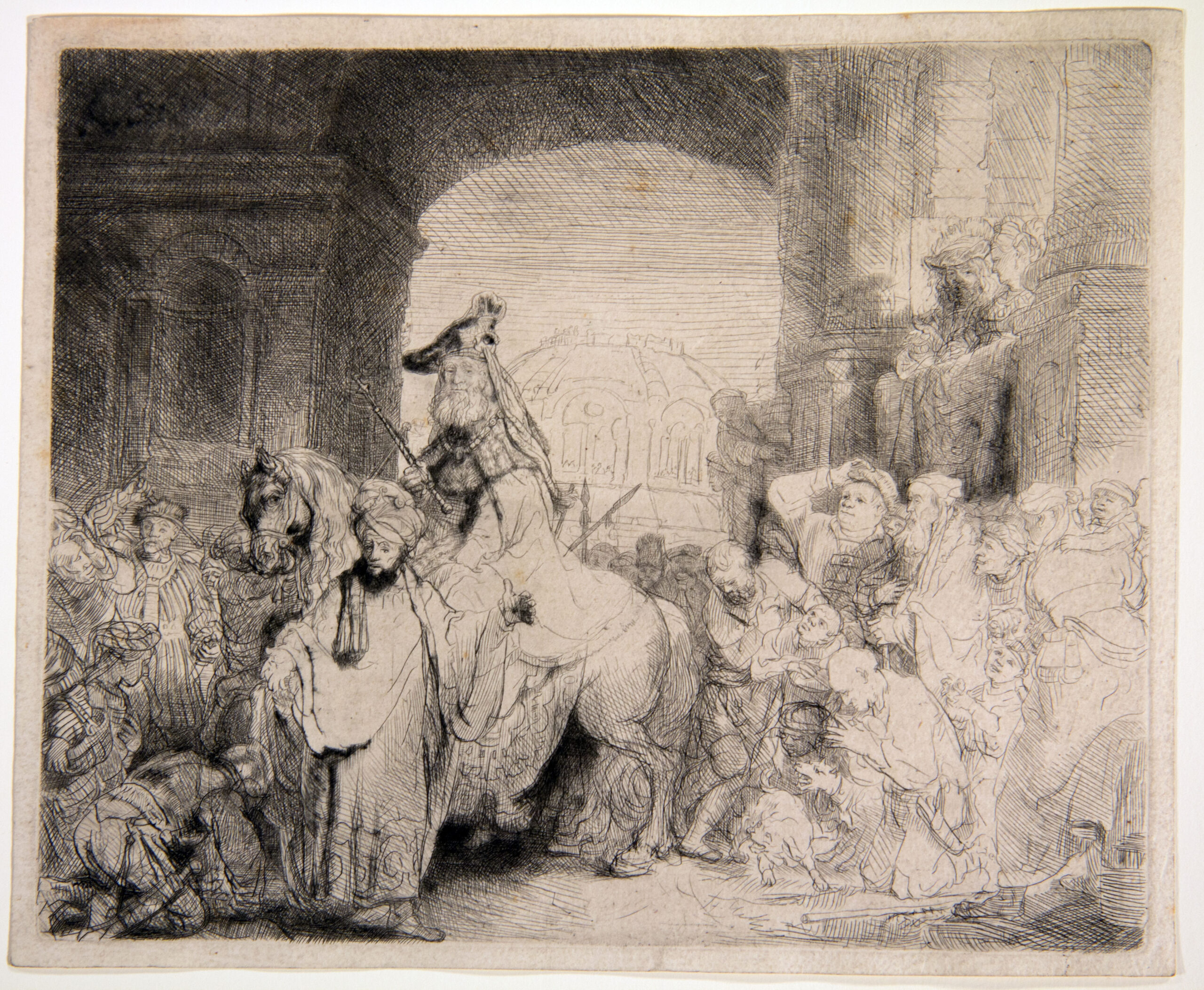
NH 185 – 3rd state of IV

Copper Plate

The copperplate was in the possession of Duke Charles Alexander of Lorraine and was sold at his auction in 1781 (Lot 102). It was used for impressions in the 18th century (see ‘States’), but is probably not anymore in existence.


Rarity of impressions

  • In auctions (2000-2025): frequent                                           Mixed: 44     Later: 4                  ⦿⦿⊙⊙⊙⊙

  • In collections (New Hollstein 2013): frequent                        Mixed: 78     Later: 3                  ⦿⦿⊙⊙⊙⊙

  • Nowell-Usticke (1967): C2, fairly common, but seldom fine                                                      ⦿⊙⊙⊙⊙⊙


Story

Esther 6, verses 10-11
The Persian king Ahasuerus asked his advisor Haman how he could best honour a man highly appreciated by the king. Haman, thinking that the king was referring to him, suggested to have the man make a triumphal parade on horseback and in the clothes of the king. The king, however, was referring to the Jew Mordecai, who warned the king years earlier against a conspiracy but was not yet rewarded for this.


Picture

In the print we see Haman, a man hating the Jews and always eager to destroy them, carrying out his own advice. On the balcony the king and his wife Esther are seated. The city gate in the background shows a strong resemblance to that painted in the Nachtwacht. The contrast with light (at right, the Jewish community?) and dark (left, the followers of Haman?) will also be used by Rembrandt when he makes his masterpiece a year later. This is the first etching in which Rembrandt makes extensive use of the drypoint.


Animal Farm

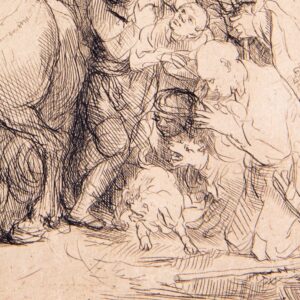
It is clear that the horse plays an important role in this story. The way it looks at Haman shows that the horse knows the evil role is playing. Is that also the reason the two dogs at right are fiercely barking?

Related

The etching is in fact the fourth in a series that started with an engraving by Albrecht Durer, Knight, Death and Devil, (B 98) followed by an engraving dated 1515 by Lucas van Leyden (B32) on which his teacher Pieter Lastman based his Haman and Mordechai (1624, now in the Rembrandthuis). All four pictures show a similar scene, although Rembrandt is the first to include the king with his wife and the arch in the background. The man under the balcony taking off his cap is directly copied from the Lucas van Leyden engraving. Rembrandt made a small painting in 1660 (now in the Pushkin Museum in Moscow, Corpus VI 283) showing the moment Esther tells her husband about the betrayal by Haman. Five years later he made a much larger painting (now in the Hermitage, Bredius 531) showing the moment Haman receives the instructions to honour Mordechai. White-Boon and Biörklund point at a preliminary study (Benesch 487, now in the Ossolinski National Institute in Wroclaw/Breslau), but this drawing is no longer considered to be by Rembrandt. Sumowski attributed it to Gerbrand van den Eeckhout. The same doubts apply to a drawing of a woman with the child on her arm, seen in another drawing (Benesch 732, in the Bredius Museum in The Hague) which is now attributed by Peter Schatborn to Carel Fabritius ). A drawing in the Louvre (Benesch 150) shows a similar background. Münz recognizes Rembrandt and Saskia in the King and his wife Esther.


Copies

New Hollstien lists three copies in reverse. Copy A is by Melchior Küsel, included in his book (1679, 94 x 139 mm). Copy B is an anonymous one which is used as illustration in Sir Thomas Herbert, Some years travel into Africa and Asia the Great, London 1677 (4th edition, p. 32, WB 2). Copy C is by Johann Elias Haid (190 x 218 mm, WB 1).


Attributions and reviews

The etching is considered as special by Coppier, Wilson and Singer.


States

The New Hollstein lists four states, introducing two new contemporary states. The final state is not by Rembrandt. Most other authors list one state only. Nowell-Usticke lists two states, the 2nd state ‘discovered’ by Barnard.
In the 1st state (NH only) the right hand of the woman grasping the basket is completely blankº. The lower part of the horse’s tail is unshaded, as is the area on the left upper hind legº.
In the 2nd state (NH only) the woman’s hand and the lower part of the tail are shadedº, but the leg is still unshaded.
Of the 3rd state (NH/1st state WB, NU, R139) very few impressions with burr have survived. The upper left corner is then really black. In some later impressions the burr is faked.
In the 4th state (NH/2nd state NU) the plate is worked over with touches of aquatint in brownish/black ink, intended to make the shadings look better*. According to Biörklund and NH at the end of the 18th century.


Prints and collections

Of the 1st state (NH) only one impression is known, in the Bibliothèque Nationale.
Of the 2nd state (NH) two impressions are known, in the British Museum and in the National Gallery (Washington).
Of the 3rd state (NH) there are at least eight counterproofs, an impression marked P.Mariette 1671 (in the Philadelphia Museum) and an impression on Japanese paper (in the Bibliothèque Nationale).
Apparently an impression in blue ink was sold at the Seratti sale in London in 1816 (lot 266).


Watermarks

In the 1st and 2nd state: Strasbourg Lily; Arms of Amsterdam; Foolscap with five-pointed collar. In the 3rd state: Foolscap with seven-pointed collar.


Literature

H 172, BB 41-1, G 39, M 228, Mz 178, RA 139, Cl 44, W 44, Bl 12, Du 48, CD 131, S 8.
Tümpel 2006, p. 43; Spijkerboer, p.126; Schwartz 2006, p. 29; Hinterding 2008, p. 91; Verdi 2014, p. 128-133; Rosenberg 2017, p. 122; Rutgers/Sandring 2018, p. 87.


Rembrandt in Black & White: 165

New Hollstein: 3rd state of IV/White-Boon: Only state.
A good, probably somewhat later print on thick laid paper. Showing burr in the lower left corner and in the shadows upper left.
Sheet 179/182 x 220 mm. Narrow margins of approx. 3 mm all around (+6%).
No watermark, vertical chain lines at approx. 27 mm.


Exhibitions

The Rotunda at Exchange Square, Hong Kong, January 2008
Rembrandt in Zwart-Wit, Museum Gouda, Jan ten Horne Museum (Weert), Stadsmuseum Harderwijk, June 2014-August 2015;Stedelijk Museum Vianen, October 2017 -January 2018;
Rembrandt in Black & White, Schloß Britz (Berlin), Chateau des Penthes (Geneva), November 2015 – October 2016;
Rembrandt, fotograaf avant-la-lettre, Museum De Reede (Antwerp), January – May 2023;
Rembrandt, 17th century photographer, Daegu Art Museum (Korea), November 2023 – March 2024;
Rembrandt, de fotograaf, Westfries Museum (Hoorn), June 2024 – January 2025;