B 103

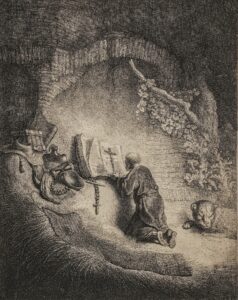
St. Jerome beside a pollard willow

  • French title:
    Saint Jerome au tronc d’arbre
  • German title:
    Der heilige Hieronymus bei dem Weidenstumpf
  • Dutch title:
    Hieronymus bij een knotwilg
  • New Hollstein:
    244
  • Rembrandt in Black & White:
    124

Etching and drypoint. 1648.
Size: 180 x 133 mm. Surface: 239 cm2.
Signed and dated in the lower centre, from the 3rd state: Rembrandt. f. 1648

NH 244 – 4th state of IV

Copper Plate

The copperplate was not part of an early collection or sale and is probably not in existence.


Rarity of impressions

  • In auctions (2000-2025): very rare                                 Early: 9                                                 ⦿⦿⦿⦿⊙⊙

  • In collections (New Hollstein – 2013): frequent             Early: 71                                                ⦿⦿⊙⊙⊙⊙

  • Catalogue Nowell-Usticke (1967): RR, a very scarce & extremely desirable print               ⦿⦿⦿⦿⊙⊙


Story

St. Jerome is one of the four Patriarchs. He lived as a hermit for four years. He was very popular in the 17th century and consequently often depicted in works of art. Almost always in the company of a lion, referring to the legend that the lion became his loyal friend when Jerome removed a thorn from its pawn. Rembrandt made no less than seven etchings (B 100 till B 106), three drawings and one painting of St. Jerome. Besides the lion there are several other elements that refer to Jerome; the cardinal’s (patriarch’s) hat, the crucifix and the skull. In the background a waterfall is vaguely visible.


Picture

Coppier and others have suggested that the tree was etched from nature and the picture completed in the studio. Is has also been suggested that the print in fact is a study of the willow (etched) to which the saint was only added later (in drypoint). The sturdy tree, known to be surviving under difficult conditions, may also be a symbol of Faith. The small new shoots are then a proof of resurrection and renewal (Dickey, Kuretsky).


Animal Farm

At the time Rembrandt made this print he had probably never seen a lion in nature. A few years later he would draw then in much more natural looks.
Apart from the well visible lion, a bird is sitting on the top of a branch.


Inspiration

It is highly likely that Rembrandt used an engraving by Albrecht Durer (Bartsch 59), of which Rembrandt was a great admirer, as an example.
Rembrandt may also have been inspired by Jerome and the small lion by Marcantonio Raimondi. Prints by Raimondi were in Rembrandt’s inventory.


Related

B&W 385Johannes van Vliet, after Rembrandt – St.Jerome reading

A painting by Rembrandt of Jerome reading is only known from a print by Johannes van Vliet (1631, Hollstein 13). It is included in the collection “Rembrandt in Black & White”, number 385. 
A small drawing (HdG 1285) in the Rijksmuseum shows a man similar to that of St. Jerome.
A drawing of a pollard willow in 1648 (Benesch 852a), in the Bibliotheca Reale in Turin, was long considered a proof for the etching, but is now considered to be made by a pupil.


Copies

There are two copies in reverse. Copy A is by Costantino Cumano (175 x 130 mm, WB 1). Copy B is anonymous, signed CER (135 x 98 mm, WB 2).


Attributions and reviews

The etching is considered as special by Rovinski and Wilson.


States

The New Hollstein lists four states, all other authors list two states, all contemporary.
In the 1st state (NH only) the signature and date are missing.
In the 2nd state (NH/1st state WB, R320) there is additional shading to the lion’s left cheek and an extra line on the right cheek.
In the 3rd state (NH) the signature is added, the leaves below the skull are shaded, the riverbank is shaded with cross-hatching and several small changes are made to Jerome.
In the 4th state (NH/2nd state WB final, R321) some diagonal lines are added to Jerome’s chest, above his right hand and behind his head. Shadow is added to the lower part of the desk, to the far left and to his left shoulder below the collar.


Prints and collections

Of all states there are impressions on Japanese paper.
There is a counterproof of the 4th state in the Rijksmuseum.


Watermarks

In the 1st and 2nd state: Foolscap with five-pointed collar (2 ed. 1648).
In the 3rd state: Strasbourg lily with cm VA’ (1648).
In the 4th state: Strasbourg lily (1648 and 1650); Foolscap with five-pointed collar with cm LB (c. 1650); Arms of Amsterdam.


Literature

H 232, BB 48-B, G 102, M 223, Mz 248, RA 320-321, Cl 106, W 108, Bl 74, Du 106, CD 190, S52.
Hinterding 2008, p. 221ff; Verdi 2014, p. 118;


Rembrandt in Black & White: 124

New Hollstein: 4th and final state/White-Boon: 2nd and final state
Early impression with much burr. Small, isolated spots, an almost invisible diagonal crease in the upper left corner.
Sheet 182 x 133/132 mm, thread margins of approx. 1 mm all around (+1%).
Watermark: Countermark WK (Ash/Fletcher WK.a), dated to ca. 1652 (Hinterding 2006, p. 278). Vertical chain lines.


Exhibitions

Rembrandt in Zwart-Wit, Westfries Museum (Hoorn), Het Markiezenhof (Bergen op Zoom), Stedelijk Museum Zutphen, Het Hannemahuis (Harlingen), Museum Gouda, Jan ten Horne Museum (Weert), Stadsmuseum Harderwijk, March 2013-August 2015; Stedelijk Museum Vianen, October 2017 – January 2018;
Rembrandt in Black & White, Chateau de Penthes (Geneva), June – October 2016;
Rembrandt, fotograaf avant-la-lettre, Museum De Reede (Antwerp), January – May 2023;
Rembrandt, 17th century photographer, Daegu Art Museum (Korea), November 2023 – March 2024;
Rembrandt, de fotograaf, Westfries Museum (Hoorn), June 2024 – January 2025;