The copperplate was in the sale by Clement de Jonghe (1679, as 44 Hieronymus met de leeuw) but has not been seen since and is probably not anymore in existence.
Rarity of impressions
In auctions (2000-2025): rare Early: 9 ⦿⦿⦿⦿⊙⊙
In collections (New Hollstein – 2013): common Early: 64 ⦿⦿⦿⊙⊙⊙
Catalogue Nowell-Usticke (1967): RR-, an extremely scarce print ⦿⦿⦿⦿⊙⊙
Story
St. Jerome (Dalmatia 347 – 420 Rome AD) is one of the four Patriarchs, best known for the Vulgate, his translation of the Bible from Hebrew and Greek into common Latin. He lived as a hermit for four years and was very popular in the 17th century. Consequently he was often depicted in works of art. Almost always in the company of a lion, referring to the legend that the lion became his loyal friend when Jerome removed a thorn from its pawn. Other artefacts related to Jerome are a cardinal’s hat and a skull. Rembrandt made no less than seven etchings (B 100 till B 106), three drawings and one painting of St. Jerome.
Picture
The title of this print relates to the ‘Mediterranean’ setting of the village in the background.
Fore- and background are separated by a diagonal line.
This etching is the last of the St. Jerome series. And the largest, apart from the very rare and probably fake B106
Title
In the De Burgy sale in 1755 this print was listed as De vermaarde Prent van den Grooten St.Hieronymus met den Leeuw. Zeer capitaal en uitneemend raar. (The well-known print of the famous St. Jerome with the lion. Very impressive and extremely rare).
Animal Farm
As in all prints of St. Jerome, the lion is well-visible. More difficult to spot: a cat on the top of the tree-trunk. Or is it a dog or a bird?
Inspiration
Rembrandt was an admirer of 16th century Venetian art. The buildings on the hill are very similar to those in an engraving by Giulio and Domenico Campagnola. Rembrandt has used this setting in several etchings of this period. The background may have been copied from Titian. Rembrandt possessed a set of engravings after his paintings. It may also have been copies from a drawing by Domenico Campagnola, once in the Wellesley Collection.
Münz assumes that Rembrandt may have used an etching by Welzer Hollar as an example for the lion.
Related
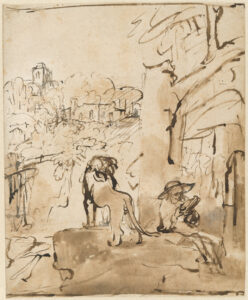
Rembrandt – St.Jerome in an Italian landscape – Kunsthalle Hamburg – Benesch 886
A painting by Rembrandt of Jerome reading is only known from a print by Johannes van Vliet (1631, Hollstein 13).
There is a drawing in reverse, dated ca. 1654 (Benesch 886, now in the Kunsthalle in Hamburg), which has probably served as a study.
Copies
There is one copy, in reverse, by Richard Byron with the landscape only (150 x 193 mm).
Attributions and reviews
The etching is considered as special by De Claussin and Coppier.
Bartsch called it a morceau rare.
States
All authors list two states, both early.
In the 1st state (NH, WB, R323) the left pillar looks narrow and has three strokes, the right one two. The edges are inky, the corners are rounded.
In the 2nd state (NH, WB, R324) the left pillar looks broader and now has five strokes, the right one three.
Prints and collections
Of the 1st state there are at least fourteen impressions known, all on Japanese paper.
Of the 2nd state there are six impressions on oatmeal and many on Japanese paper.
An impression of the 1st state on Japanese paper was sold in the auction of the Josefowitz collection in December 2023 at Christie’s in London for £ 1.250.000.
Watermarks
In the 2nd state: Strasbourg bend (1653), Strasbourg lily, Paschal lab, Foolscap with five and seven-pointed collar (3 ed.), Arms of Amsterdam (2 ed.) and Arms (3 ed.).
Literature
H 267, BB 53-3, G 104-105, M 234, Mz 249, RA 322-324, Cl 107, W 109, Bl 75, Du 107, CD 224, S 53-55. Hinterding 2008, p. 224ff; Verdi 2014, p. 119;
Rembrandt in Black & White: 228
New Hollstein/White-Boon: 2nd and final state
A somewhat later impression, probably made by Clement de Jonghe around 1673. Showing burr in the manes of the lion.
Sheet 255/257 x 208 mm, cut at the platemark or slightly within (-/- 2%).
Watermark: Foolscap with seven-pointed star (Laurentius 489, first documented in 1673) and countermark IR (not identified). Horizontal chain lines at approx. 23 mm.
Exhibitions
Rembrandt, fotograaf avant-la-lettre, Museum De Reede (Antwerp), January – May 2023; Rembrandt, 17th century photographer, Daegu Art Museum (Korea), November 2023 – March 2024; Rembrandt, de fotograaf, Westfries Museum (Hoorn), June 2024 – January 2025;