B 97

The stoning of St.Stephen

  • French title:
    Le Martyre de St.Etienne
  • German title:
    Die Steinigung des heiligen Stephanus
  • Dutch title:
    De steniging van Stefanus
  • New Hollstein:
    140
  • Rembrandt in Black & White:
    203

Etching and some burin. 1635.
Size: 95 x 85 mm. Surface: 81 cm2.
Signed and dated, in the lower left corner: Rembrandt. f. 1635

NH 140 – 1st state of IV

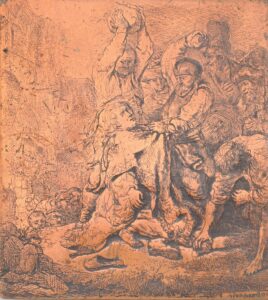
Copper Plate

B 97 – The stoning of St.Stephen – Copperplate – Rijksmuseum

The copperplate was in the sale by Pieter de Haan (1767, lot 35) and was sold via Fouquet to Claude-Henri Watelet (1718-1786). It then became part of the set of plates subsequently owned and used for printing Recueils by Pierre-François Basan (1723-1797), Henri-Louis Basan (his nr 1404), Auguste Jean (ca 1809), Veuve Jean, Auguste and Michel Bernard (1846), Alvin-Beaumont (1906) and Robert Lee Humber (1937). It was sold at the Artemis sale in London (1993) and became part of the collection of Simon Schama, author of “De Ogen van Rembrandt”, (The eyes of Rembrandt) and was donated by him to the Rijksmuseum in 2023.


Rarity of impressions

  • In auctions (2000-2025): very frequent                             Early: 17     Late: 17     Unknown: 24              ⦿⊙⊙⊙⊙⊙

  • In collections (New Hollstein 2013): frequent                                        Early: 31 – Late: 46                     ⦿⦿⊙⊙⊙⊙

  • Catalogue Nowell-Usticke (1967): C2+, a fairly common small plate                                                      ⦿⊙⊙⊙⊙⊙


Story

Acts of the Apostles 6, verses 55-60.
St. Stephen was brought to court by the priests. In his testimony he told the court that he had a vision in which God appeared to him. This so much offended the Jewish Council that, before even being sentenced, he was taken out of town and stoned to death. During the stoning he prayed and cried out ‘Lord, Jesus, receive my spirit’ and ‘Lord, lay not this sin to their charge’. With that he became the first Christian martyr. Tümpel has pointed out that St.Stephen was always shown in combination with the stoning in the 16th century. Dudok van Heel, unconvincingly, assumes that there is a hiding message here, related to the stone-throwing that Remonstrants were victims of in the early part of the 17th century.


Inspiration

Münz and Muller suggest that a painting by Rembrandt’s teacher Pieter Lastman may have served as a prototype for this plate. The painting is lost but a drawing of it is in the Kupferstichkabinett in Berlin (KdZ 10323,) Especially the person picking up a stone is remarkably similar.


Related

RembrandtThe stoning of St.StephenMusée des Beaux-Arts, Lyon – Corpus A1


Rembrandt painted the same subject ten years earlier (Corpus A1, Musée des Beaux-Arts in Lyon).


Copies

NH list six copies, of which one in the same direction, an anonymous copy G (98 x 88 mm).
There are six copies in reverse. Copy A is by Melchior Küsel inscribed Actor. Cap. VII. Stephanus lapidatur (1679, 93 x 140 mm). Copy B is by Michael Wening, inscribed S.Stephanus and numbered 170 (1693). Copy C is by Jan de Ridder (104 x 88 mm, WB). Copies D, E and F are anonymous (resp. 93 x 84 mm, 100 x 86 mm and 97 x 88 mm).


Attributions and reviews

The etching is considered as special by De Claussin.
The plate is not by Rembrandt according to Singer.


States

The New Hollstein lists four states, only the 1st by Rembrandt. Most other authors list two states, Nowell-Usticke four, from his 2nd state there are later impressions by Watelet, P.Basan, Basan, Jean, Bernard and Beaumont.
The 1st state (NH, WB, R305) is before the work mentioned hereunder. There are fine vertical scratches above the shoe, through the robe and to the right of the shoe and robe. A fine clear line directly beneath the signature, which faints in later impressions of this state (NU). The rays are clearly visible.
In the 2nd state (NH only) the shadows are reworked with a rocker. Not by Rembrandt.
In the 3rd state (NH/2nd state WB final, NU Watelet?, P.Basan, Basan, Jean) the shadows are reworked with fine hatching. Diagonals cover the head of the man at the top of the left margin.
In the 4th state (NH/3rd state NU Jean) the burin was used for retouching the lower left leg, which appears to be thicker now. A heavy patch of shadow is at the base of the heel.
In the 4th state (NU Bernard, Beaumont) the plate is reworked completely. The rays are hardly visible. No shading in the upper left corner.


Prints and collections

There are counterproofs of the 3rd state in the Fitzwilliam Museum (Cambridge) and the Albertina.
There are impressions of the 3rd state in red ink in the Fitzwilliam Museum and in Coburg.


Recueils

The etching appears in the Recueil de Basan, impressions fairly strong (NU).
B&W 54 – Recueil de Basan – Page 3                      NH: 3rd state of IV/WB: 2nd and final state.
A good, sharp and dark impression.

B&W 206 – Recueil de Beaumont –  Sheet 35      NH: 4th and final state/WB: 2nd and final state.
A good impression. The shading in the air is almost gone.


Watermarks

In the 1st state: Pascal lamb (1651).
In the 3rd state: Strasbourg lily.


Literature

H 125, BB 35-A, G 98, M 197, Mz 205, RA 305, Cl 100, W 102, Bl 68, Du 100, CD 98
Tümpel p. 120; C.Müller: Studien zu Lastman und Rembrandt, in Jahrbuch der Preussischen Kunstsammlungen, 1929 pp. 45-83; Schama 1999, p. 233; A. van Deursen in Kroniek van het Rembrandthuis, 2006/1-2, Amsterdam 2006, page 28-33. S.A.C.Dudok van Heel, De jonge Rembrandt onder tijdgenoten, Nijmegen 2006. Hinterding 2008, p. 210-211;


Rembrandt in Black & White: 203

New Hollstein: 1st state of IV/White-Boon: 1st state of II
A good, dark impression on laid paper of the only contemporary state. The rays of sunlight clearly visible.
Sheet: 98 x 88/87 mm, narrow margins of 1- 2 mm all around (+7%).
No watermark. The chain lines not yet identified, because the paper is glued to a support sheet.