
B 72

The raising of Lazarus, small plate

  • French title:
    Resurrection de Lazare, petite
  • German title:
    Die kleine Auferweckung des Lazarus
  • Dutch title:
    De opwekking van Lazarus (klein)
  • New Hollstein:
    206
  • Rembrandt in Black & White:
    33

Etching. 1642.
Size: 150 x 114 mm. Surface: 171 cm2.
Signed and dated in the lower left corner: Rembrandt f. 1642 (the 2 in reverse).

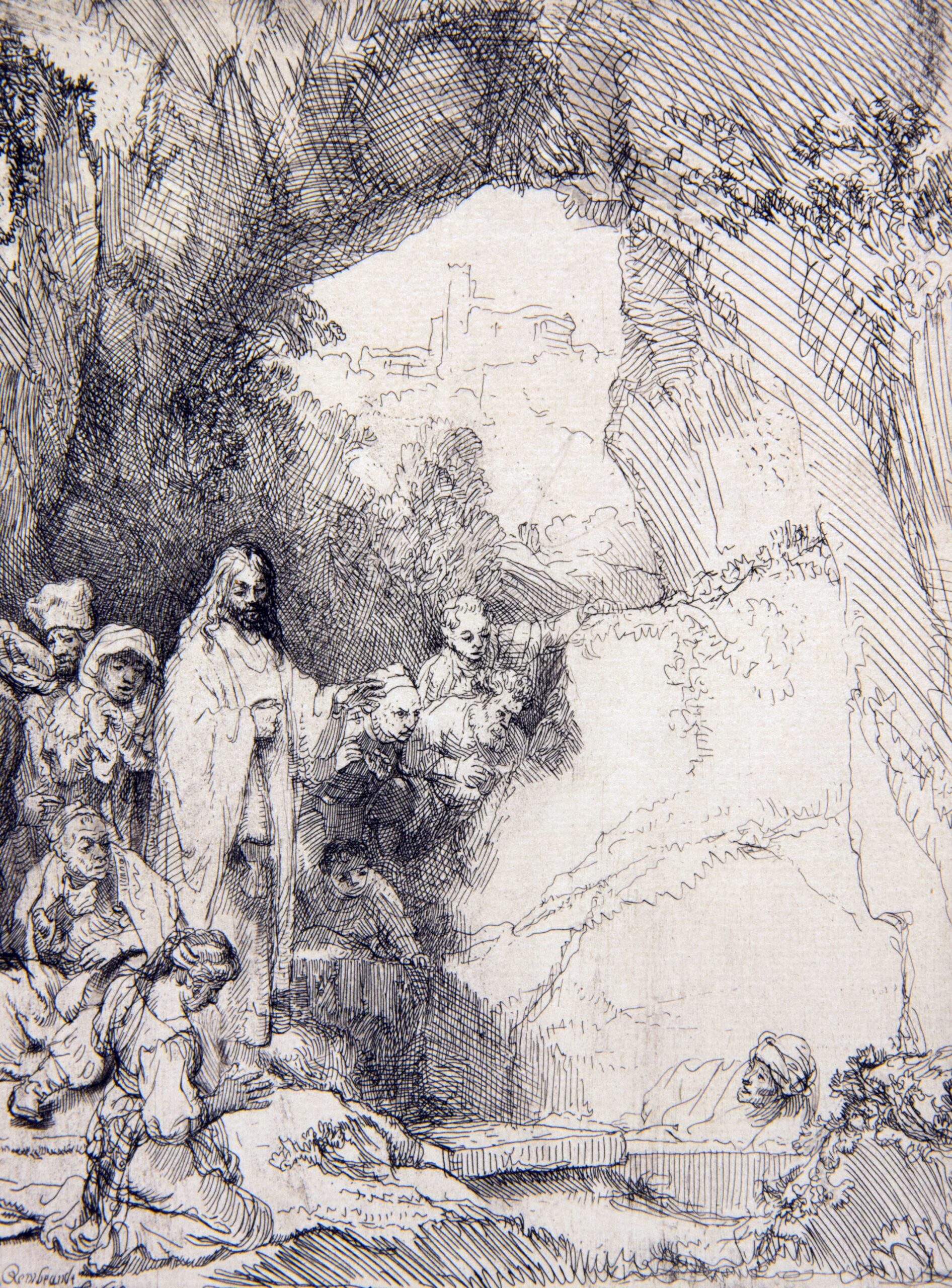
NH 206 – 1st state of II

Copper Plate

The copperplate was probably in the collection of Clement de Jonghe (1679, as 37 Lasarus opweckingh). It was in the collection of Nicolaas Visscher (ca. 1680) and then in the sale of Jean de Bary (1759, lot 42) where sold to Ottens and later to Claude-Henri Watelet (1718-1786). It then became part of the set of plates subsequently owned and used for printing Recueils by Pierre-François Basan (1723-1797), Henri-Louis Basan (his nr 1395), Auguste Jean (ca 1809), Veuve Jean, Auguste and Michel Bernard (1846), Alvin-Beaumont (1906) and Robert Lee Humber (1937). It was sold at the Artemis sale in London (1993) and is now in the Museum of Fine Arts in Boston.


Rarity of impressions

  • In auctions (2000-2025): very frequent                                                Early: 32     Late: 41                      ⦿⊙⊙⊙⊙⊙

  • In collections (New Hollstein 2013): very frequent                             Early: 81     Late: 25                      ⦿⊙⊙⊙⊙⊙

  • Catalogue Nowell-Usticke (1967): C2-, a common print, impressions usually good                            ⦿⊙⊙⊙⊙⊙


Story

John 11, verses 1-44.
The raising of Lazarus is in essence the story of victory over death. Jesus arrived in the town of Bethany four days after Lazarus, a brother of Maria Magdalena, had died. Jesus is moved by the sorrow of Maria. Although warned that the body may be smelly after four days, He asks for the stone to be removed. He then calls Lazarus out.


Picture

Some ten years earlier Rembrandt made a larger etching about this subject (B73), much more theatrical than this small version. Here Christ seems to be a bystander instead of the performer of a miracle. The audience does not seem to be very impressed. In the background the city of Bethany is visible. This picture is much more intimate than the earlier version. Even Lazarus seems to be more ‘alive’ than in B73


Inspiration

Münz assumes that the etching was inspired by an engraving made after a painting by Rubens (now in Berlin).


Related

RembrandtThe raising of Lazarus – 1630-32 – 95 x 81 cm – Los Angeles County Museum – Corpus A50

Rembrandt made a painting of the same subject about ten years earlier (Corpus A30, now in the Los Angeles County Museum).


Copies

New Hollstein lists four copies of which two in the same direction. Copy C is anonymous, inscribed Rembrandt 1631 (149 x 112 mm). Copy D is also anonymous, signed Rembrandt f. 1642 (149 x 112 mm, WB 1).
There are two copies in reverse. Copy A is published by Hertel inscribed Rembrandt fecit and Hertel excud. (two states, his nr 224, 147 x 114 mm, WB 3). Copy B is by John Smith of Chichester, inscribed Rembrandt f 1642 in reverse (148 x 113 mm, WB 2).


Attributions and reviews

The etching is considered as special by Coppier.


States

As most authors, the New Hollstein lists two states, of which the second not by Rembrandt. Nowell-Usticke lists three states, from his 2nd state there are later impressions by Watelet, P.F. Basan, Jean, Bernard and Beaumont.
In the 1st state (R226) there are three small vertical lines behind the head of Lazarus. Early impressions are sharp and clear, with much burr on the left-right shading on the chest of the kneeling woman. In later, probably posthumous impressions the three lines become weak.
In the 2nd state (R227) the forehead of Lazarus is darkened with diagonal lines°. The lines behind his head have almost disappeared. Early impressions by P. Basan are good. In later impressions by Jean the three lines are virtually invisible. The shading on the chest of the woman is weak. In the first series published by Jean this plate was replaced by a roughly etched copy.
In the 3rd state (NU) Bernard has reworked the plate. The lines in front of the woman’s chest woman are now broken.


Prints and collections

There are several counterproofs of the 1st state, like in the Rijksmuseum, the Fitzwilliam’s Museum (Cambridge), the Bibliothèque National and the Albertina.


Recueils

The etching appears in the Recueil de Basan, impression fine (NU).

B&W 54 – Recueil de Basan – Page 5                      NH, WB: 2nd and final state
A good impression, the lines on the forehead of Lazarus well visible, the lines behind his head very weak.

B&W 206 – Recueil de Beaumont –  Sheet 26      NH, WB: 2nd and final state
A good impression.


Watermarks

In the 1st state: Arms of Amsterdam; Foolscap with five and seven-pointed collar; various countermarks; Grapes; Paschal lamb; Seven Provinces.
In total at least fourteen editions are identified so far.


Literature

H 198, BB 42-B, G 73 , M 215, Mz 214, RA 226-227, Cl 76, W 76, Bl 47, Du 78, CD 153
Rembrandts Passie p. 103-106; Tümpel 2006, p. 71-73; Tromp & Maas 1999, p. 145-167; Hinterding 2008, p. 150-151;


Rembrandt in Black & White: 33

New Hollstein/White-Boon: 1st state of II
A good, early impression with burr around the woman front left. The small vertical lines behind the head of Lazarus are well visible, confirming an early impression if the 1st state. Light discolouration in the margins.
Sheet 177/176 x 134/133 mm, very wide margins of 14 mm at the bottom and 10 mm at the other sides (+39%).
No watermark, vertical chain lines at approx. 32 mm.


Provenance

In the collection of the American chemist and collector William Pelletier (Kankakee 1924-2004 Athens GA, Lugt 4193), his collector’s stamp in greyish ink verso. In the mark handwritten in black ink 1966 and 5-5-06; It was in the posthumous sale of his collection with Sotheby´s in London in December 2004, where unsold.


Exhibitions

The Rotunda at Exchange Square, Hong Kong, January 2008
Rembrandt in Zwart-Wit, Stedelijk Museum Zutphen, November 2013-February 2014;
Rembrandt, fotograaf avant-la-lettre, Museum De Reede (Antwerp), January – May 2023;