B 73

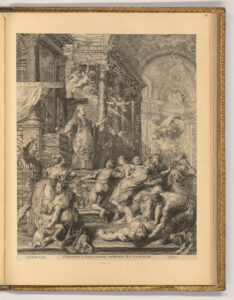
The raising of Lazarus: the larger plate

  • French title:
    La résurrection de Lazare, grande
  • German title:
    Die grosse Auferweckung des Lazarus
  • Dutch title:
    De opwekking van Lazarus – groot
  • New Hollstein:
    113
  • Rembrandt in Black & White:
    185

Etching. Ca. 1632.
Size: 366 x 258 mm. Surface: 944 cm2.
Signed RHL van Rijn f., not dated.

NH 113 – 5th state of IX

Copper Plate

The copperplate was probably in the collection of Clement de Jonghe (1679, as 37 Lazarus opweckingh). It later appeared in the sale of Pieter de Haan (1767, lot 24) and was sold via Fouquet to Claude-Henri Watelet (1718-1786). It then became part of the set of plates subsequently owned and used for printing Recueils by Pierre-François Basan (1723-1797), Henri-Louis Basan (his nr 1394), Auguste Jean (ca 1809), Veuve Jean, Auguste and Michel Bernard (1846), Alvin-Beaumont (1906) and Robert Lee Humber (1937). It was sold at the Artemis sale in London (1993) to Dr H. Berger (Beverly Hills). In 1998 the plate was used to produce approx. 2500 prints as the Millennium Impressions. In 2003 it was sold, together with seven other plates, to Park West Galleries in Southfield, Michigan. They probably drew many more impressions from the now worn plate. For more details see the separate chapter on the Millennium Impressions.


Rarity of impressions

  • In auctions (2000-2025): very frequent                                                 Early: 14     Late: 64                     ⦿⊙⊙⊙⊙⊙

  • In collections (New Hollstein 2013): very frequent                             Early: 40     Late: 64                     ⦿⊙⊙⊙⊙⊙

  • Catalogue Nowell-Usticke (1967): C1, A fairly common large plate                                                         ⦿⦿⊙⊙⊙⊙


Story

John 11, verses 1-44
Jesus arrived in the town of Bethany four days after Lazarus, a brother of Maria Magdalena, had died. Jesus is moved by the sorrow of Maria. Although warned that the body may be smelly after four days, He asks for the stone to be removed. He then calls Lazarus out. The story of victory over death by the raising of Lazarus is often seen as a prelude to Jesus’ own destiny. Some ten years later Rembrandt made a second etching about this subject (B72). This early version is much more theatrical than the later one. By turning Jesus with his back to the viewer, all attention is focused on Lazarus and the shocked bystanders, including Martha and Maria on the right. The artefacts on the wall are derived from the Legenda Aurea and are referring to the life of Lazarus as a soldier (Tümpel). It is the first large etching of a biblical subject and is one of the largest etchings in his oeuvre. Hinterding suggested that Rembrandt added the dark frame in order to make the print look like a painting. It may well be very deliberate, since Rembrandt and Jan Lievens, his studio companion, were competing for commissions for Biblical paintings from Stadholder William


Inspiration

Marinus van der Goes (after Rubens) – The miracle of St.IgnatiusThe Albertina


Münz mentions a list of Dutch paintings that may have inspired Rembrandt. He thinks that the main source is a painting by Rubens, The miracle of St.Ignatius (in the Albertina) probably through an engraved copy by Marinus Robin van der Goes.


Related

RembrandtThe Entombment of Christ (over The raising of Lazarus) – 1630 – 280 x 204 mm – British Museum – Benesch 17
RembrandtThe raising of LazarusLos Angeles County Museum – Corpus A30

In the same period Rembrandt made a painting of the same subject (Bredius 538, Corpus A30, now in the Los Angeles County Museum). Although there are some differences, like the position of Christ behind the grave in the painting, X-Ray research has indicated that the painting was initially more in line with the etching, making it highly likely that Rembrandt worked on them simultaneously.

A drawing The Raising of Lazarus (Benesch 17, now in the British Museum) dated 1630 was later renamed Entombment of Christ. There is also a sketch in Munich.
According to Münz, Rembrandt worked on studies of this subject as part of the Passion series of paintings commissioned by stadhouder Frederik Hendrik at about the time he made this etching.


Copies

The large number of copies proof the early popularity of this print. Five are in the same direction. Copy C is by J.G.Hertel (his nr 38, 145 x 100 mm, WB 2). Copy F is anonymous signed Rt.Inv and RHL v. Ryn f. (251 x 355 mm). Copy G is by Dominique Vivant, inscribed RH van Ryn f. (413 x 292 mm, WB 1). Copy L is a mezzotint by William Dunkerton, inscribed Rembrant pinx.t (470 x 318 mm). Copy N is a wood engraving by Lavieille after a drawing by Louis Marvy, included in Blanc’s catalogue (185 x 126 mm).
There are nine copies in reverse. Copy A is an signed engraving by Melchior Küsel (360 x 258 mm, WB 4). B is an anonymous engraving (345 x 226). Copy D is an engraving by John Holland with only Christ and Lazarus, inscribed Rt.Inv (203 x 141 mm). Copy E is an etching with mezzotint by Johann Elias Haid, signed Rembrandt del. J.E.Haid fecit (344 x 235 mm, WB 3). Copy H is a signed etching by Constantino Cumano (382 x 271 mm, WB 5). I is an anonymous engraving (363 x 252 mm). Copy J is an anonymous wood engraving (405 x 280 mm). K is an anonymous engraving (339 x 232 mm, WB 6, not traced by NHD). Copy M is an etching by Robert Palgrave, inscribed R (in three states, 118 x 80 mm).


Attributions and reviews

The etching is considered as special by Bartsch, De Claussin and Blanc.
The plate was made by a pupil according to Middleton, Coppier and Singer.


States

The New Hollstein lists nine states of which the final four not by Rembrandt. Most other authors list ten states, Middleton and Münz twelve, Biörklund nine. Nowell-Usticke lists four trial proofs and ten states. From his 4th state there are later impressions by Watelet, P.Basan, Basan, Jean, Bernard and Beaumont. Münz suggested that the large number of states indicates that this is the first plate in which Rembrandt worked, and even experimented, with assistants (Lievens?). Some states are only known from earlier descriptions. Impressions of these states are not available.
The number of states is not only large, it is also confusing, since other artists made many alterations later. Hinterding (NH) considers some ‘states’ to be retouched versions of other states, leading to a total of nine instead of ten states. He leaves out the states of which no prints are available.
In the 1st state (NH/WB, R228/NU trial proof A) the arched frame is lightly shaded, with false biting there and elsewhere. The man with the arms outstretched is bareheaded against a white background. The bearded man wears a skull-cap. The woman on the right is seen from behind. The ‘f’’ of the signature is missing.
In the 2nd state (NH/WB, R229/NU trial proof B) the outline of Christ’s leg is completed. The arched border is reworked, some white spaces are shaded (3rd state WB, R230/NU trial proof C).
In the 3rd state (NH/4th state WB, R231/1st state NU) the arched border is filled with cross-hatching. The woman in the lower right corner is now bending forwards and seen in profile and the ‘f’ is added to the signature (5th state WB, R232).
In the 4th state (NH/6th state WB) the man with the outstretched arms wears a high cap°.
In the 5th state (NH/8th state WB, R234/3rd state NU) the bearded man in the background now wears a turban. The right leg of the man with outstretched arms is redrawn. The heads of the two men in the background are redrawn. There are many other small corrections. NH considers the plate to be finished at this stage, all later states are not by Rembrandt and are only meant to remedy the wear.
In the 6th state (NH/9th state WB, R235) some rework with the rocker in several places. Rocker-lines protrude at the right side of the right curtain°.
In the 7th state (NH/10th state WB final, R237) crosshatching is added all over the plate.
In the 8th state (NH) the plate is completely reworked.
In the 9th state (NH) many lines are redrawn or doubled, many contours strengthened.


Prints and collections

Of the 1st state (WB 1st and 2nd) three impressions exist, in the Albertina (R228), in the British Museum and one in the Rijksmuseum in which the outline of the leg is completed with pen and grey ink.
Of the 2nd state (WB 3rd and 4th) three impressions are known. In one impression in the Bibliothèque Nationale the border is altered with graphite to test the changes made in the 3rd state.
Of the 3rd state (WB 5th) five impressions are known.
Of the 4th state (WB 6th) only one impression is known, in the Albertina.
Despite the obvious wear of the plate, Rembrandt never altered the 5th, in his eyes final, version.
The 6th (WB 9th) state of this etching appears in the first edition of the Recueil de Basan, impressions very good (NU). In later editions the plate is heavily reworked.


Recueils

B&W 54 – Recueil de Basan – Page 42                   NH: 8th state of IX/WB: 10th and final state.
A somewhat weak impression, certainly when compared with B&W 185 and the Recueil de Beaumont.

B&W 206 – Recueil de Beaumont –  Sheet 27      NH: 9th and final state/WB: 10th and final state.
A pretty strong and dark impression, mainly due to the many redrawn lines and strengthened contours of the final, state.


Watermarks

In the 1st, 2nd and 5th state: Strasbourg bend (c. 1632). In the 3rd state: Arms of Bern (c. 1632).
In the 5th state: Basilisk (3 ed. c. 1632-47); Strasbourg lily, with initials and countermarks;
In the 6th state: Arms; Countermark RL’; Fleur-de-lis; Strasbourg lily with WR and 4WR (3 ed.); Strasbourg bend (3 ed.); Words.
In the 7th state: Countermarks DG’ and L; Grapes; Strasbourg lily with WR; Words.


Literature

H 96, BB 32-4, G 74, M 188, Mz 192, RA 228-237, Cl 77, W 77, Bl 48, Du 79, CD 74
Rembrandts passie, p. 103-106; Tümpel 2006, p. 71-73; Tromp & Maas 1999, p. 145-167; Hinterding 2006, p. 79-83 Rohde 2006, p. 25; Hinterding 2008, p. 152ff; The Painter at Work 2009, p. 40-41


Rembrandt in Black & White: 185

New Hollstein: 5th state of IX/White-Boon: 8th state of X
A probably somewhat later impression of the last state made by Rembrandt. Impression on yellowish paper (oatmeal?).
Sheet 380 x 268 mm, margins of 5 to 6 mm all around (+8%).
Part of an unidentified watermark, vertical chain lines at approx. 28mm.


Provenance

Probably in the collection of William Edwards (c. 1754-1821 Bath, Lugt 2616), based on a collector’s mark WE, verso.
It was probably in the posthumous sale of this collection with Christie’s in London in May 1822.
In the collection of Richard Fisher (1809-1890, Hill Top – Midhurst, Lugt 2204) his collector’s mark in black ink verso.
Probably in the posthumous sale of his collection with Sotheby’s in London in May 1892.


Exhibitions

Rembrandt in Black & White, Schloß Britz (Berlin), Bozar Expo (Brussels), Chateau des Penthes (Geneva), November 2015- October 2016;
Rembrandt in Zwart-Wit, Stedelijk Museum Vianen, October 2017-January 2018;
Rembrandt, fotograaf avant-la-lettre, Museum De Reede (Antwerp), January – May 2023;
Rembrandt, 17th century photographer, Daegu Art Museum (Korea), November 2023 – March 2024;
Rembrandt, de fotograaf, Westfries Museum (Hoorn), June 2024 – January 2025;