B 39

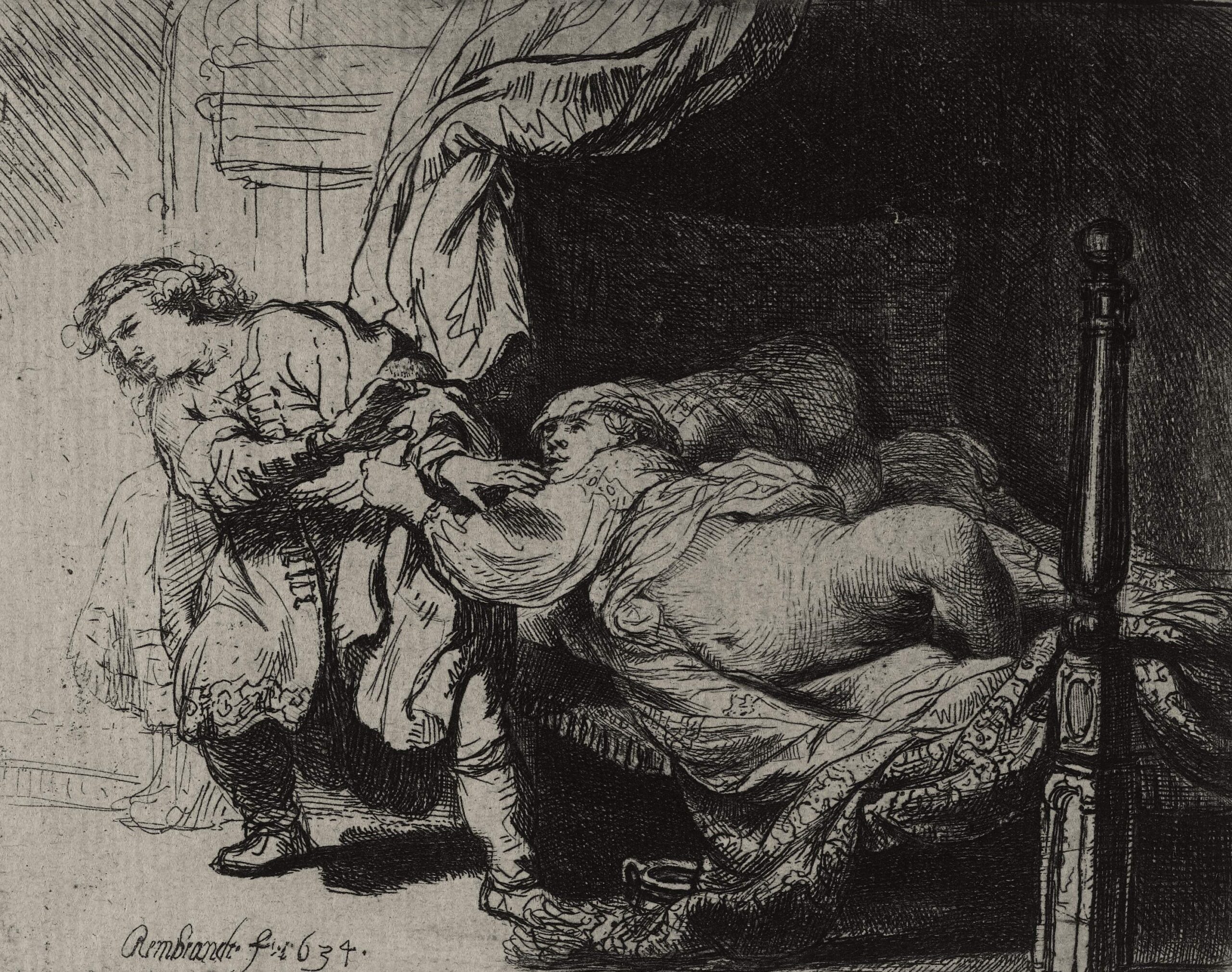
Joseph and Potiphar’s wife

  • French title:
    Joseph et la femme de Putiphar
  • German title:
    Joseph und Potiphars Weib
  • Dutch title:
    Jozef en de vrouw van Potifar
  • New Hollstein:
    128
  • Rembrandt in Black & White:
    159

Etching. 1634.
Size: 90 x 115 mm. Surface: 104 cm2.
Signed and dated, in the lower left corner: Rembrandt. f. 1634. 

NH 128 – 3rd state of IV

Copper Plate

The copperplate was in the sale by Pieter de Haan (1767, lot 8) and was sold for Fl. 7,00 via Fouquet to Claude-Henri Watelet (1718-1786). It then became part of the set of plates subsequently owned and used for printing Recueils by Pierre-François Basan (1713-1797), Henri-Louis Basan (his nr 1376), Auguste Jean (ca 1809), Veuve Jean, Auguste and Michel Bernard (1846), Alvin-Beaumont (1906) and Robert Lee Humber (1937). It was sold at the Artemis sale in London (1993) is now in Museum Het Rembrandthuis on a long term loan from a private collector.


Rarity of impressions

  • In auctions (2000-2025): frequent                            Early: 4     Later: 19     Unknown: 22     ⦿⦿⊙⊙⊙⊙

  • In collections (New Hollstein 2013): common                 Early: 24     Later: 42                      ⦿⦿⦿⊙⊙⊙

  • Nowell-Usticke (1967): C, fairly common                                                                                       ⦿⦿⊙⊙⊙⊙


Story

Genesis chapter 39, verses 10-12
During his exile in Egypt Joseph was sold to Potiphar, a courtier of the Pharaoh. Joseph was able to win the confidence of Potiphar and became the chief of his household staff. But then Potiphar’s wife tried to seduce him, which Joseph resisted. Rembrandt shows the moment that Joseph tries to escape. Potiphar’s wife is trying to grab Joseph but is only able to grab his coat. She will later use this coat to convince Potiphar that it was Joseph who seduced her.


Picture

Rembrandt made a dramatic picture, by placing the scene in the bedroom, with the seductress on the bed. The lower part of her body is naked, while usually only the upper part is shown naked. The woman is in the middle of a dark area, Joseph is fleeing into the light left part of the picture. The long leg of the bed is often seen as a phallic symbol. Note the stool under the bed. Is Joseph only trying to escape or was he primarily disgusted by the sight and the smell?


Related

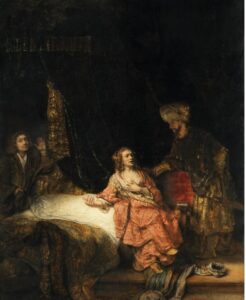
Bredius 524, Gemäldegalerie, Berlin


More than twenty years later Rembrandt made a painting of the same subject (Bredius 524, now at the Gemäldegalerie in Berlin), but then at the moment the wife falsely accuses Joseph, by pointing at his coat. Rembrandt was probably inspired by an engraving (B 54) made in 1613 by Antonio Tempesta (1555-1630) of whom he owned several albums. The stool is also seen in an engraving by Lucas van Leyden, dated 1512. The subject of seduction was very popular with painters in that period, but most pictured the seduction itself, not the following false accusation, as Rembrandt does.


Copies

The New Hollstein lists five copies in the same direction. Copy A is an anonymous one, inscribed Rembrandt fc. 1634 (two states, 88 x 112 mm, WB 3).
Copy B is also an anonymous one (99 x 115 mm). Copy C is published by Hertel, inscribed Rembrandt del. N. 50 L.G.Hertel exc. A.V. (78 x 112 mm, WB 2).
Copy D is by Ignace Joseph De Claussin, inscribed Rembrandt f. 1634 (90 x 114 mm, WB 1). Copy E is a later anonymous woodcut (88 x 103 mm, WB 5).
There is one anonymous copy in reverse, signed Rembrandt fe. 1634. In this copy the bedclothes reach up to the navel (WB 4, not in NH).


Attributions and reviews

The etching is considered as special by Coppier and De Claussin.
Daulby criticized Rembrandt for not “having treated this subject with the decency which is due to the sacred source from whence it was derived” (sic).


States

New Hollstein lists four states of which only the first by Rembrandt. Most authors list two states, Nowell-Usticke five, from his 2nd state there are later impressions by Watelet, P.Basan, H.Basan, Jean, Bernard and Beaumont.
In the 1st state (NH, WB, R136, NU) the upper right back of the bedstead is rounded (NU).
In the 2nd state (NH, NU) there is fine shading added with a rocker. Best visible are the protruding lines of the rocker on the right flap of Joseph’s coat next to his knee°, on the little finger of his left hand, on the cushion to the right of the woman’s left knee and the bedpost.
In the 3rd  state (NH, NU P. and H. Basan /2nd state WB, R137) there are strong left-to-right diagonals in the upper right corner and horizontals on the lower part of the bedpost.
In the 4th state (NH, NU) there is further retouching in the shadows and a few left-right diagonal cross lines on the small oval on the bedpost.
In the 5th state (NU only, Jean, Bernard, Beaumont) the diagonal lines in the oval on the bedpost are removed


Prints and collections

There is a counterproof of the 1st state in the Rijksmuseum and of the 3rd state in the Fitzwilliam’s Museum. The etching appears in the Recueil de Basan, impressions good (NU).


Watermarks

In the 1st state: Arms of Württemberg (c. 1634); Foolscap with seven-pointed collar;
In the 3rd state: Foolscap with seven-pointed collar;


Literature

H 118, BB 34-G, G 36, M 192, Mz 173, RA 136-138, Cl 43, W 43, Bl 11, Du 43, CD 87.
Lloyd Williams 2001, p. 106; Spijkerboer 2006, p. 70; Dat kan beter! 2013, p. 52; Rosenberg 2017, p. 116.


Rembrandt in Black & White: 159

New Hollstein: 3rd state of IV/White-Boon: 2nd state of II.
A good, but slightly later print.
Sheet 122/120 x 166 mm, very broad margins of 27 mm at both sides, 12 mm at the top and 16 mm at the bottom (+94%).
Watermark: part of Grapes with countermark N? Horizontal chain lines at approx. 26 mm.


Exhibitions

Rembrandt in Zwart-Wit, Museum Gouda, July – October 2014;Stedelijk Museum Vianen, October 2017 – January 2018;
Rembrandt in Black & White, Schloß Britz (Berlin), November 2015 – February 2016;
Rembrandt, fotograaf avant-la-lettre, Museum De Reede (Antwerp), January – May 2023;
Rembrandt, 17th century photographer, Daegu Art Museum (Korea), November 2023 – March 2024;
Rembrandt, de fotograaf, Westfries Museum (Hoorn), June 2024 – January 2025;