B 67

Christ preaching (‘La petite tombe’)

  • French title:
    Jesus Christ prechant ou la petite tombe
  • German title:
    Christus lehrend
  • Dutch title:
    Christus predikend (‘La Petite Tombe’)
  • New Hollstein:
    298
  • Rembrandt in Black & White:
    114

Etching and drypoint. Ca. 1657.
Size: 156 x 206 mm. Surface: 321cm2.
Not signed, not dated. It was originally dated in 1652, but Münz dates it later than other authors, 1656, which dating is confirmed by watermark research.

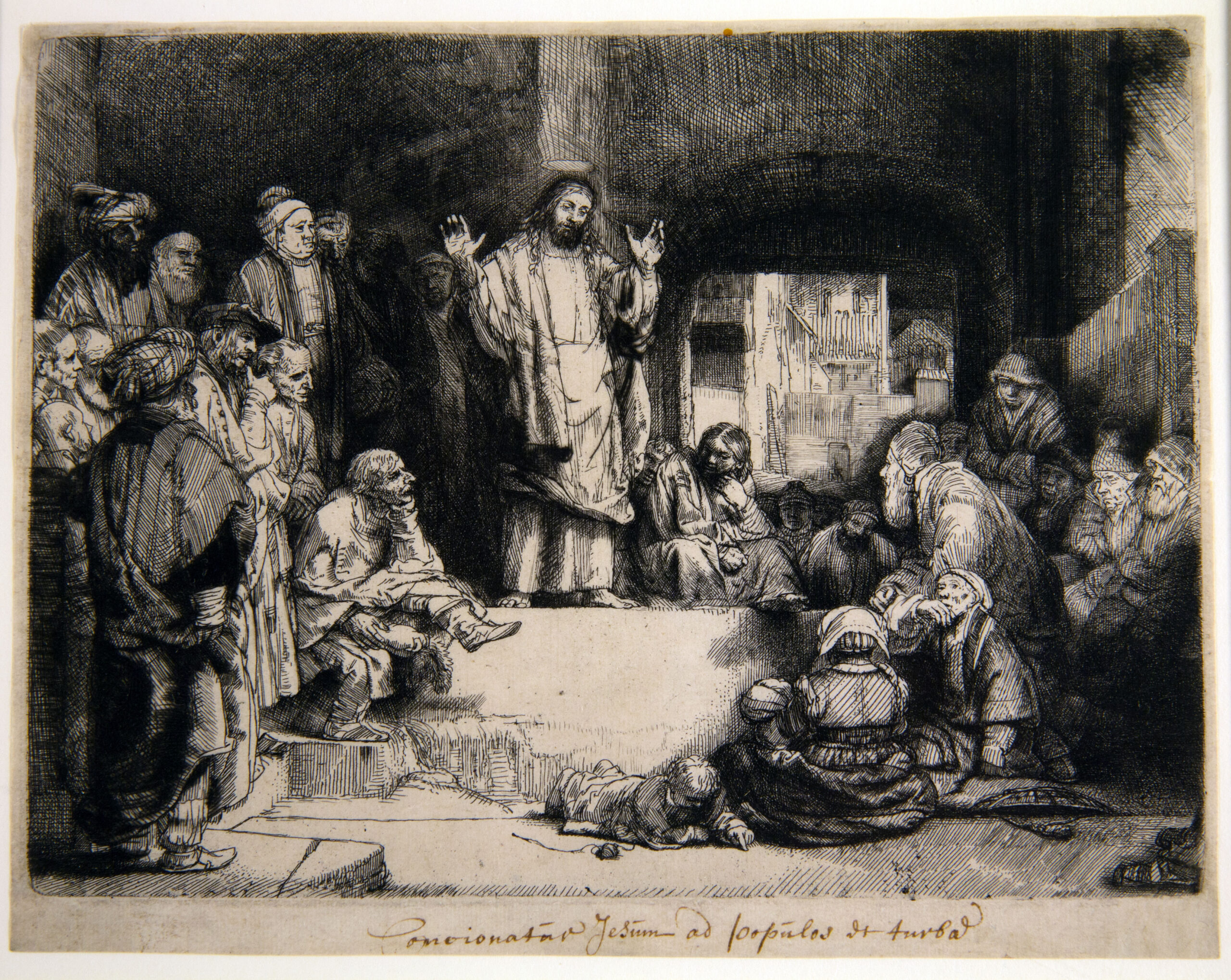
NH 298 – 1st state of II

Copper Plate

The copperplate was probably owned by Nicolaes de la Tombe. It was then in the sale by Clement de Jonghe (1679, as 1 Latombisch plaatjen). Later it was included in the sale by Jean de Bary (1759, lot nr 36) and sold to Yver. It was probably also owned by Jean-Pierre Norblin la Gourdaine (London) and may have been retouched by him. The plate was acquired by Colnaghi (London) in 1830, but has not been seen since. It may still be in existence.


Rarity of impressions

  • In auctions (2000-2025): Very frequent                                               Early: 55     Late: 9                         ⦿⊙⊙⊙⊙⊙

  • In collections (New Hollstein 2013): very frequent                             Early: 104     Late: 1                      ⦿⊙⊙⊙⊙⊙

  • Catalogue Nowell-Usticke (1967): C2: A rather common plate, fine impressions much desired       ⦿⊙⊙⊙⊙⊙


Subject/Sitter

The scene pictured here has a stark resemblance to that of the famous Hundred Guilder Print (B74), made about eight years earlier. It is clearly one of those moments cited in the Bible when Jesus is preaching, but the exact moment and location cannot be related as clearly as in the case of B74.


Picture

By putting the twenty five persons in a circle and in a confined space, the print has a more intimate character than B74. The white floor in the middle works as a reversed halo. It seems to lighten Christ. The opening in the wall provides for depth. Some of the faces of the men listening are portraits on their own.
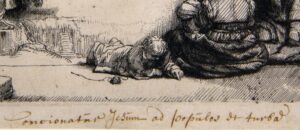
B 76 – NH 298: Detail

Note the child playing on the foreground, drawing with his finger in the sand, the only person not paying attention to Christ.


Title

The name La petite tombe is, erroneously, given by Gersaint in his catalogue based on the description in the catalogue of the De Jonghe sale and has survived since. In fact the title refers to Nicolaes or Pieter de la Tombe. Both had relations with Rembrandt. One of them may have commissioned the etching and owned the copperplate.


Related

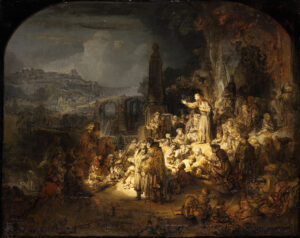
RembrandtSermon of John the Baptist – 1634-35 – 63 x 81 cm – Gemäldegalerie Berlin – Corpus A106 – Bredius 555


Rembrandt made a painting of John the Baptist preaching, which has a similar setting (Corpus A106).

Münz saw a likeness with an engraving by Adriaan Collaert after Maarten de Vos, around 1635.


Copies

The New Hollstein lists six copies of which two in the same direction. Copy A is a very deceptive one by James Bretherton (156 x 205 mm, WB 1). Copy C is anonymous, inscribed Rembrandt in (151 x 202 mm).
There are four copies in reverse. Copy B is by Francesco Novelli (two states, his nr 9, 168 x 219 mm, WB 2). Copy F is by John Burnet (64 x 68 mm). Copies D and E are anonymous (resp. 152 x 204 and 164 x 203 mm) .


Attributions and reviews

The etching is considered as special by Seidlitz, Coppier and Singer.


States

The New Hollstein lists two states, the second not by Rembrandt. Most other authors list one state only. Nowell-Usticke lists three states, from his 2nd state there are later impressions by Watelet and possibly Norblin.
Early impressions of the 1st state (NHD, WB, R215) are also known as the ‘black sleeve’ version, referring to heavy burr on the garment of Jesus, the beard of the man in the top left corner and especially on the sleeve of the man standing in the left foreground. These versions were for a long time sold at much higher prices than the ‘white sleeve’ versions, which were assumed to be of later date. Biörklund points out that this is not correct and that the black sleeve was often achieved by adding ink after wiping the plate and not due to burr.
In the 2nd state (NHD, NU) the background shading is heavily retouched (possibly by Norblin) making the background full of burr.
Nowell-Usticke considers it difficult to describe.


Prints and collections

There are counterproofs in the British Museum and the Albertina.
Of the first state there are more than a hundred impressions of which 14 on Japanese paper and two on Chinese paper. One impression in the Rijksmuseum is printed on silk.


Watermarks

In the 1st state: Arms of Amsterdam; Foolscap with five-pointed collar; Strasbourg lily; IHS and various countermarks.


Literature

H 256, BB 52-2, G 66, M 229, Mz 236, RA 215-216, Cl 71, W 71, Bl 39, Du 71, CD 214, S30/31.
Rembrandts passie, p. 99; Rohde 2006, p. 15; Hinterding 2008, p. 140-143;


Rembrandt in Black & White: 114

New Hollstein: 1st state of II/White-Boon: only state
A very good, contemporary impression on Oriental (Chinese?) paper.
Sheet 167 x 211 mm, margins of approx. 3 to 4 mm all around (+10%).


Exhibitions

Rembrandt in Zwart-Wit, Westfries Museum (Hoorn), Het Markiezenhof (Bergen op Zoom), Stedelijk Museum Zutphen, Het Hannemahuis (Harlingen), Jan ten Horne Museum (Weert), Stadsmuseum Harderwijk, March 2013 – August 2015; Stedelijk Museum Vianen, October 2017 – January 2018;
Rembrandt in Black & White: Bozar Expo (Brussels), March – June 2016;
Rembrandt, de fotograaf, Westfries Museum (Hoorn), June 2024 – January 2025;