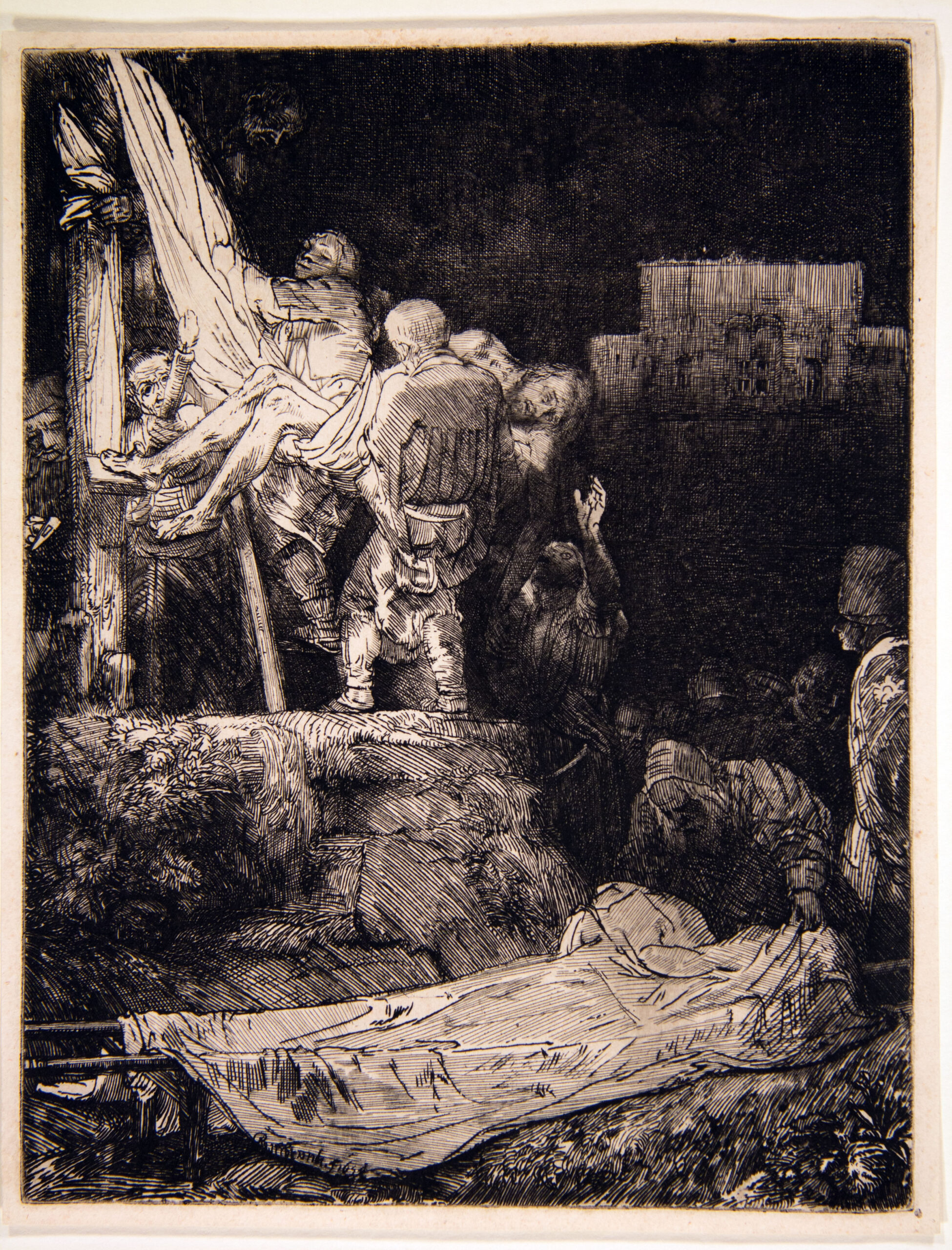
Etching and some drypoint. 1654.
Size: 210 x 161 mm. Surface: 338 cm2.
Signed and dated, in the lower margin, at left: Rembrandt. f. 1654 (the ‘a’ in reverse).
The copperplate was in the sale by Clement de Jonghe (1679, as 27 afdoening vant cruys). The next, anonymous owner added two dots (ca. 1700). It later appeared in the sale of Pieter de Haan (1767, lot 28) and was sold via Fouquet to Claude-Henri Watelet (1718-1786). It then became part of the set of plates subsequently owned and used for printing Recueils by Pierre-François Basan (1723-1797), Henri-Louis Basan (his nr 1399), Auguste Jean (ca 1809), Veuve Jean, Auguste and Michel Bernard (1846) and Robert Lee Humber (1937). It was sold at the Artemis sale in London (1993) and is now in the Pierpont Morgan Library in New York.
Rarity of impressions
In auctions (2000-2025): very frequent Early: 18 Late: 31 Unknown: 50 ⦿⊙⊙⊙⊙⊙
In collections (New Hollstein 2013): very frequent Early: 65 Late: 36 ⦿⊙⊙⊙⊙⊙
Catalogue Nowell-Usticke (1967): C2-, a common print, fine impressions much sought after ⦿⊙⊙⊙⊙⊙
Story
John 19, verses 38-40
Joseph of Arimethea, a secret follower of Jesus, got permission from Pilatus to remove the body of Jesus from the cross to bury Him. Here the action is seen when the body is wrapped in linen and taken off by a group of followers.
Picture
The last of the three prints on this subject follows the Bible more closely than the first two (B 81 and 82), by putting the action at night. It also focuses on the descent itself, the mourning ladies are not seen or in the shadows. The only light comes from a torch held by one of his disciples. Only the lower part of the cross is visible, the body is almost ready to be laid in the linen cloth that Joseph of Arimathea is preparing in the forefront. The man handling the body clearly has difficulty holding it on his own, but at right someone is ready to assist him.
Related
In 1654 Rembrandt made four prints very similar in style and size, B50, B86, B87 and this one. They may well have been meant as a series about important moments of His life and death.
Copies
The New Hollstein lists four copies of which only one (D) in the same direction. It is anonymous, inscribed Rembrandt in. (248 x 174 mm, WB 1).
There are three copies in reverse. Copy A is by Francesco Novelli, signed and dated 1790 (two states, 244 x 202 mm, WB 2). Copy B is anonymous, signed and dated SF 1813 (154 x 102 mm, WB 3, not traced by NHD). Copy C is a small version by John Burnet, inscribed Rembrandt and numbered Fig 1, included in Burner 1826 (98 x 76 mm).
Attributions and reviews
The etching is considered as special by Seidlitz, Coppier and Singer.
States
The New Hollstein lists four states, only the first by Rembrandt. The 2nd state (two dots) is ’new’. Most other authors list one state, Biörklund two. Nowell-Usticke lists three states, from his 2nd state there are later impressions by P.Basan, Basan, Jean, Bernard and Beaumont.
The 1st state (R269-270) has square corners, before the shading in the upper right corner.
In the 2nd state (NH only) an unknown owner added two dots in the upper right corner.
In the 3rd state (NH/2nd BB, NU, P.Basan, H.Basan, Jean) regular diagonal right-to-left shading is added in the upper right part of the sky. In later impressions a heavy diagonal left-to-right scratch of approx. 50 mm appears, starting in the upper right corner.
In the 4th state (NH) the entire plate is rebitten and reworked. The sky is very black with cross diagonal left-to-right shading, especially in the upper right corner.
Prints and collections
Early impressions show burr on the two men supporting Christ. There are impressions on Japanese paper.
There are 18th century impressions in red ink, probably made by Picart (one in the Lugt collection in Paris).
There is a counterproof in the British Museum.
Of the 2nd state (NH only) six impressions are known.
Recueils
The etching appears in the Recueil de Basan, impressions fairly good (NU).
B&W 54 – Recueil de Basan – Page 23 NH: 3rd state of IV/WB: only state.
The two dots in the upper right corner are clearly visible.
B&W 206 – Recueil de Beaumont – Sheet 30 NH: 4th and final state/WB: only state.
A dark impression, due the extensive rework, especially in the sky, which is completely black.
Watermarks
In the 1st state: various countermarks (3 ed.); Foolscap with five- and seven-pointed collar (4 ed.); Grapes; Strasbourg bend and others.
In the 2nd state: Seven Provinces (after 1665).
In the 3rd state: Grapes; Countermark DG and various others.
Literature
H 280, BB 54-G, G 86, M 242, Mz 232, RA , Cl , W , Bl , Du CD, S 42/43. Tümpel 2006, p. 84-87; Hinterding 2008, p. 183ff; Late Rembrandt p. 180;
Rembrandt in Black & White: 155
New Hollstein: 1st state of IV/White-Boon: only state
A strong, well-printed impression before the additional shading in the top right corner. Could be a somewhat later impression, but without the two dots in the upper right corner, typical for the 2nd state. Some burr is still visible on the chest of the man on the ladder and on the beard of Christ.
Sheet 217 x 168/170 mm, margins of 3 to 5 mm all around (+8%). Printed on thick, yellowish Japanese (?) paper.
Provenance
In the collection of the Fogg Art Museum of the Harvard University (Cambridge MA, Lugt 4835), their duplicate stamp verso;
In the collection of MC (or HC) (Lugt 1860d?) according to a partially cut note on the old passe-partout:
Exhibitions
Rembrandt in Zwart-Wit, Stedelijk Museum Zutphen, Jan ten Horne Museum (Weert), Stadsmuseum Harderwijk, November 2013-August 2015; Rembrandt, de fotograaf, Westfries Museum (Hoorn), June 2024 – January 2025;