B 102

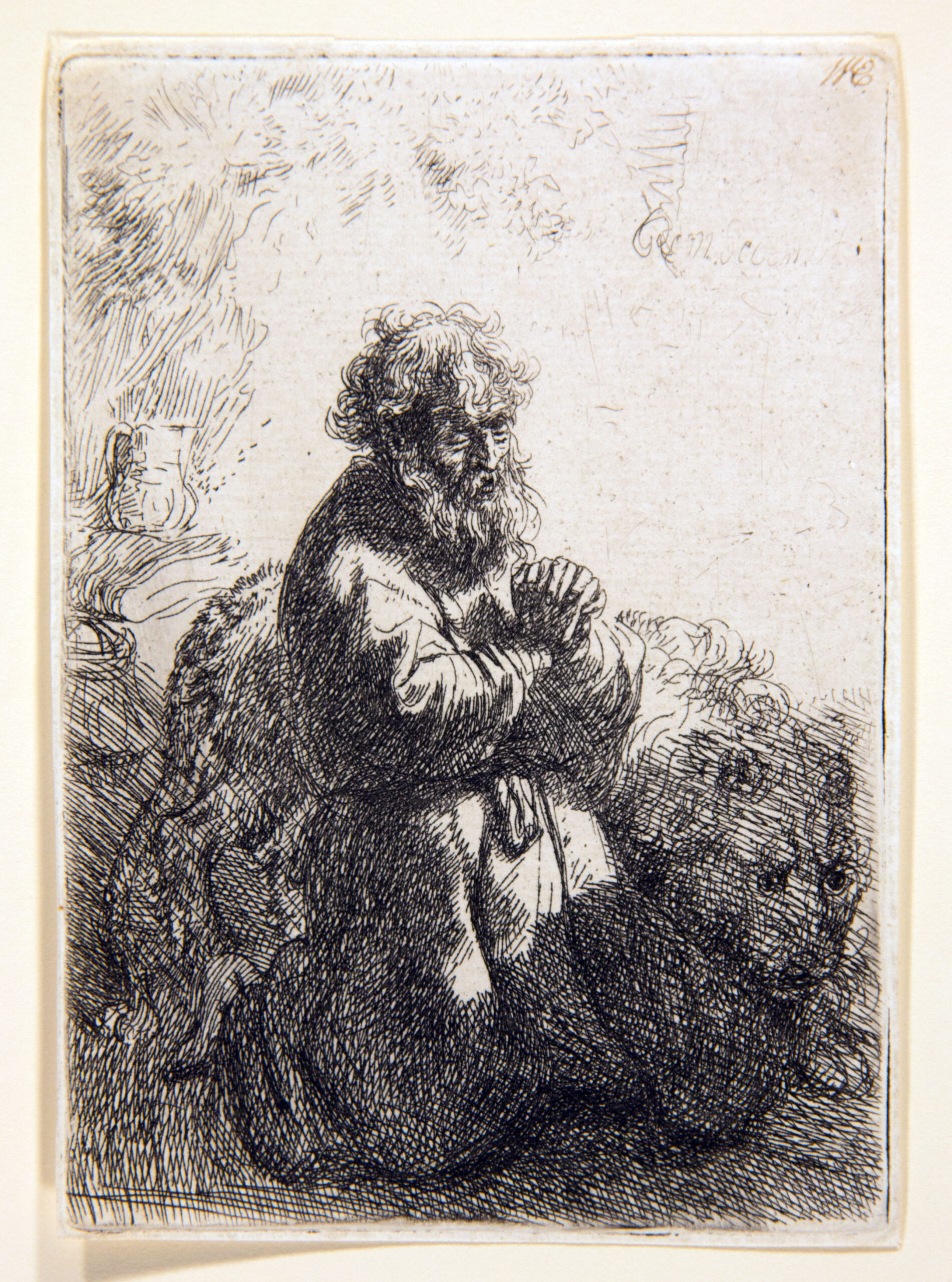
St. Jerome kneeling in prayer, looking down

  • French title:
    St. Jerome a genoux
  • German title:
    Der heilige Hieronymus im Gebet niederblickend
  • Dutch title:
    Hieronymus, geknield in gebed
  • New Hollstein:
    142
  • Rembrandt in Black & White:
    55

Etching. 1635.
Size: 114 x 80 mm. Surface: 91 cm2.
Signed and dated, in the upper right corner: Rembrandt f. 1635 (‘d’ in reverse, ‘5’ hardly readable)

NH 142 – 1st state of II

Copper Plate

The copperplate was in the collection by Clement de Jonghe (1679, as 21 Daniel onder de leeuwen). It was then in the sale by Jean de Bary (1759, lot 48) where sold to Kleinhens and later Claude-Henri Watelet (1718-1786). It became part of the set of plates subsequently owned by Pierre-François Basan (1723-1797), Henri-Louis Basan (his nr 1405), Auguste Jean (ca 1809), Veuve Jean, Auguste and Michel Bernard (1846), Alvin-Beaumont (1906) and Robert Lee Humber (1937). It was sold at the Artemis sale in London (1993) and is now in the Baltimore Museum of Art.


Rarity of impressions

  • In auctions (2000-2025): frequent                                               Early: 13    Late: 23    Unknown: 16      ⦿⦿⊙⊙⊙⊙

  • In collections (New Hollstein – 2013): frequent                                    Early: 66   Late: 4                        ⦿⦿⊙⊙⊙⊙

  • Catalogue Nowell-Usticke (1967): C1, fairly common                                                                                  ⦿⦿⊙⊙⊙⊙


Story

St. Jerome is one of the four Patriarchs, also known for his translation of the Bible in Latin. He lived as a hermit for four years. He was very popular in the 17th century and consequently often depicted in works of art. Almost always in the company of a lion, referring to the legend that the lion became his loyal friend when Jerome removed a thorn from its pawn. Other artefacts related to Jerome are a cardinal’s hat and a skull. Rembrandt made no less than seven etchings (B 100 till B 106), three drawings and one painting of St. Jerome.


Picture

In this etching the lion can be seen behind the kneeling and praying Jerome. By leaving large parts of Jerome’s skirt untouched Rembrandt creates the impression of full sunlight illuminating the Saint.


Related

Rembrandt used a model for Jerome that also appears in other etchings.


Copies

The New Hollstein lists six copies of which one (copy E) in the same direction (93 x 78 mm).
There are five copies in reverse. Copy A is by Willem van Vliet, executed by Hertel (his nr 13, two states, 109 x 81 mm, WB 3). Copy B is by Anthonie de Vos (1677, 84 x 59 mm, WB 2). Copy C is by P.F. Basan (117 x 81 mm, WB 4). Copy D is an anonymous copy inscribed Rembrandt fec, signed WB (120 x 85 mm). Copy F is by Danckert’s workshop (106 x 58 mm, WB 1)


Attributions and reviews

Münz thinks the work is made by a pupil, possibly Ferdinand Bol, where Rembrandt has only taken care of the finishing touch.
The etching is not by Rembrandt according to Coppier and Singer.


States

The New Hollstein lists two states, the 2nd state not by Rembrandt. Most other authors list one state, Nowell-Usticke lists three states, from his 2nd state there are later impressions by P. Basan, Jean and Bernard.
In the 1st state (NH, WB only, R319) the background is not cleaned, the signature is clear. In later impressions the last part of the signature becomes less visible.
In the 2nd state (NU) The plate is cleaned at the left side.
In early impressions of P.F.Basan there is a short diagonal right-left scratch under the ‘ndt’ of the signature. In later impressions, among them by Jean, only the letter R of the signature is still visible.
In the 2nd state (NH/3rd state NU) the whole plate is reworked and retouched and darker compared to the 1st state. The lines are stronger. Horizontal strokes are added to the elbow. The triangular white spot under the right sleeve is covered with thin vertical lines°.


Prints and collections

There are counterproofs of the 1st state in the British Museum and the Albertina.


Recueils

Nowell-Usticke considers the impressions (without rework) in the Recueil de Basan to be very good.
Recueil de H.L. Basan – Page 8                  NH: 1st state of II/WB: only state.
A good impression of the 1st state, the signature not visible, the short stroke, first seen in the P. F. Basan Recueils, is well visible.

Recueil de A. Beaumont –  Sheet 36        NH: 2nd and final state/WB: only state.
A darker impression. Details, like the head of the lion, are difficult to see, due to the reworking of the plate.


Watermarks

In the 1st state: Arms of Amsterdam (2 ed.); Foolscap with seven-pointed collar.


Literature

H 140, BB 35-H, G 103, M 199, Mz 246, RA 319, Cl 105, W 107, Bl 73, Du 105, CD 96
Hinterding 2008, p. 220-221; Verdi 2014, p. 110ff;


Rembrandt in Black & White: 55

New Hollstein: 1st state of II/ White-Boon: Only state
A good, probably contemporary impression of the 1st state. The signature still well readable, the short stroke next to signature not visible, indicating an early impression.
Sheet: 118/117 x 83/82 mm, thread margins of approx. 1 mm all around (+3%).
No watermark, vertical chain lines at approx. 25 mm.


Provenance

In the collection of William Esdaile, a banker and collector of prints and drawings (1758-1837, Clapham Common – London, Lugt 2617). His collector’s mark (WE) in brown ink both in the top right corner recto and bottom margin verso;
Esdaile’s collection was sold by his heirs in five sections, between 11 and 29 June 1840. This impression was sold at Christie’s London on 11-16 June 1840 (Lot 714) for £ 2,4s to Mr. White.


Exhibitions

The Rotunda at Exchange Square, Hong Kong, January 2008;
Rembrandt in Black & White, Chateau de Penthes (Geneva), June – October 2016;